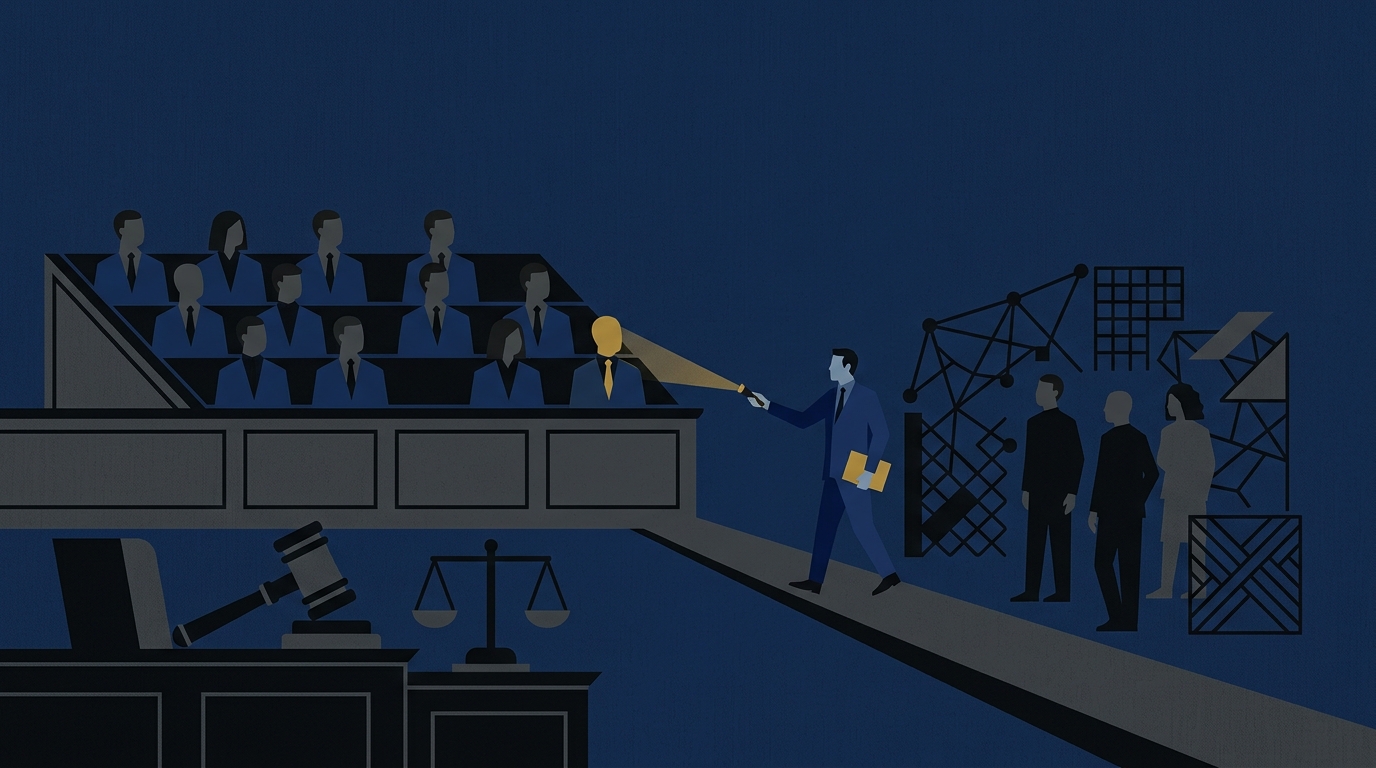
White-Collar Crime Juries: Selection Challenges for Federal Prosecutors
By David R. Drwencke · · 10 min read
The Direct Answer
White-collar crime juries present federal prosecutors with a distinct selection problem: the jurors most capable of following complex financial evidence — educated, market-savvy, higher-income individuals — are often statistically the least likely to convict, while jurors more inclined toward guilty verdicts frequently lack the background to parse dense documentary proof without coaching. Add in strict limits on peremptory strikes under Federal Rule of Criminal Procedure 24, heightened Batson scrutiny, and a federal venire that may have no connection to the industry at issue, and white-collar jury selection becomes less about finding "pro-prosecution" jurors and more about finding jurors who can absorb complexity without either defaulting to cynicism about corporate wealth or reflexively deferring to executive authority. That tension — competence versus conviction-proneness — is the central strategic puzzle in white-collar voir dire.
Why White-Collar Jury Selection Differs From Ordinary Criminal Trials
In a street-crime prosecution, the government's task in voir dire is comparatively simple: screen for jurors who can evaluate witness credibility, physical evidence, and straightforward causation. White-collar prosecutions flip that model. The evidence is often thousands of pages of emails, spreadsheets, wire transfers, and accounting entries. The "victim" may be an abstraction — a market, a shareholder class, a regulatory scheme — rather than a person the jury can see was harmed. And the defendant frequently looks nothing like the jury's mental image of a criminal: well-dressed, articulate, previously respected in the community.
This creates what trial consultants describe as a competing narratives problem. Prosecutors need jurors willing to trust a document-heavy fraud story and draw an inference of criminal intent from paper trails. Defense counsel need jurors willing to demand context, attribute conduct to business judgment or negligence rather than fraud, and resist compressing a complicated commercial failure into a simple crime narrative. Voir dire in these cases is not primarily about rooting out overt bias — it's about identifying which narrative frame a juror is predisposed to accept before a single exhibit is shown.
The Demographic Paradox Facing Federal Prosecutors
Who Tends to Convict, and Who Doesn't
Research into white-collar jury composition has identified a pattern that should concern any Assistant U.S. Attorney building a strike list. Jurors who are men — particularly White men — college graduates, higher-income earners, active market participants (investors, 401(k) holders who follow markets), and consumers of business and executive-focused news coverage have consistently shown themselves less likely to convict in fraud and financial-crime trials. These jurors often identify, at least subconsciously, with the defendant's professional world. They understand that businesses fail, that aggressive accounting isn't always criminal, and that hindsight bias can make ordinary risk-taking look like intentional deception after the fact.
By contrast, older non-White women and women without college degrees have tended to be more conviction-prone in these same case types. These jurors are less likely to extend the benefit of the doubt to corporate executives and may be more receptive to a straightforward "they had money and power, and they abused it" narrative — precisely the narrative prosecutors often want to tell.
The Implicit Bias Problem Prosecutors Must Navigate
The harder challenge for the government isn't identifying obviously biased jurors — it's managing implicit reactions that don't announce themselves during questioning. A juror who expresses generalized skepticism toward "Wall Street" or "big corporations" may seem like a prosecution-friendly pick on its face. But that same skepticism can curdle into skepticism about the prosecution itself once jurors perceive the case as government overreach, excessive resources spent chasing a business dispute, or a prosecutor trying to criminalize a judgment call. Financial-crime cases invite juror suspicion not only of the defendant's wealth but of the government's motives, funding, and use of cooperating witnesses who received favorable deals. Prosecutors who assume anti-corporate sentiment automatically favors conviction are misreading the room.
Federal Rule Constraints on Strategy
Peremptory Challenges Under Rule 24
Federal Rule of Criminal Procedure 24 governs how many peremptory strikes each side receives. In felony cases, the government and the defense are each generally entitled to 10 peremptory challenges, with additional strikes made available when the court decides to impanel alternate jurors. Ten strikes sounds like a meaningful tool for shaping a white-collar panel, but in practice it is quickly consumed. A single voir dire round may reveal four or five jurors with strong market ties on one side and several jurors expressing overt anti-corporate sentiment on the other — prosecutors must choose which risk to prioritize removing, knowing they cannot eliminate every unfavorable profile.
Batson, J.E.B., and Flowers: The Limits on Pattern Strikes
Those 10 strikes are not unconstrained. Batson v. Kentucky, 476 U.S. 79 (1986), prohibits peremptory challenges based on race, and J.E.B. v. Alabama ex rel. T.B., 511 U.S. 127 (1994), extended that prohibition to gender-based strikes. Because white-collar-favorable and white-collar-unfavorable juror profiles correlate with demographic categories — sex, race, education, income — prosecutors face genuine risk of a Batson or J.E.B. challenge even when their strike rationale is entirely legitimate (e.g., striking a juror for expressing distrust of financial institutions, not for that juror's race or gender).
Flowers v. Mississippi, 588 U.S. 284 (2019), reinforced that courts will look closely at patterns of strikes across a case, not just isolated challenges, when assessing discriminatory intent. A prosecutor who repeatedly strikes jurors who happen to share a demographic trait — even for facially race-neutral reasons tied to occupation, education, or media consumption — should expect defense counsel to raise a Flowers-style pattern argument, and should be prepared to articulate specific, individualized, non-demographic reasons for every strike.State-Level Reform Pressure
Some states have gone further than federal Batson doctrine in response to concerns that the traditional three-step Batson framework is too easily satisfied by pretextual explanations. Washington's General Rule 37, for example, lowers the bar for finding purposeful discrimination and expressly disallows certain justifications — such as a juror's distrust of law enforcement — that federal courts might otherwise accept. While GR 37 is a state court rule, it signals a broader judicial trend toward distrust of race- and gender-correlated strike patterns, a trend federal prosecutors should anticipate spreading into federal practice discussions even if it hasn't been formally adopted.
Venue and the Federal Jury Pool Problem
Federal juries are drawn from the district in which the case is charged, which in white-collar matters can mean a venire with little firsthand familiarity with the specific industry, transaction type, or business culture at issue. A securities fraud case tried in a district with limited financial-sector employment may seat jurors who have never reviewed a prospectus, executed a trade, or worked inside a corporate finance department. That knowledge gap cuts both ways: it can make jurors more receptive to a simplified prosecution narrative, but it also means prosecutors cannot assume shared context and must build financial literacy into their case presentation from the opening statement forward, rather than relying on jurors to fill gaps with outside knowledge.
Why Prosecutors Resist Bench Trials
Given all these complications, it might seem tempting for the government to prefer a bench trial in complex financial cases, letting a judge parse dense records without needing to translate everything for a lay audience. In practice, DOJ prosecutors often resist waiving the jury. The prevailing view inside U.S. Attorney's Offices is that jurors react viscerally to the fact that the government — after a lengthy, resource-intensive investigation — brought charges at all. That institutional credibility, the "the government wouldn't charge this if it weren't serious" instinct, is a real asset with a lay jury that a skeptical judge, trained to scrutinize government overreach, may not extend nearly as readily. The jury box, despite its unpredictability, remains strategically valuable to the government.
Practical Guidance by Perspective
For Federal Prosecutors
The winning approach isn't chasing jurors who "hate corporations." It's identifying jurors capable of following financial evidence on its own terms — without either reflexive cynicism about wealth or reflexive deference to executive authority. Voir dire questions should probe media consumption habits, investment experience, and attitudes toward institutional accountability, not just occupation.
For White-Collar Defense Counsel
The mirror-image goal is finding jurors predisposed to demand context before accepting a fraud narrative — jurors who understand that business failure and criminal intent are not the same thing, and who will insist the government prove specific intent beyond a reasonable doubt rather than inferring it from complexity alone.
For Corporate Defense Teams
In parallel civil exposure or multi-defendant matters, corporate counsel must think beyond the individual trial and consider how strike patterns and voir dire themes in a related criminal case could affect reputational framing in civil discovery or shareholder litigation down the line.
For Plaintiffs' Counsel in Related Civil Actions
Plaintiffs pursuing civil fraud or securities claims arising from the same conduct should study the criminal voir dire record closely — juror attitudes toward corporate accountability documented in a parallel criminal proceeding can inform civil jury selection strategy even where the legal standards and burdens of proof differ substantially.
FAQ
How many peremptory challenges do each side get in a federal white-collar felony trial? Under Federal Rule of Criminal Procedure 24, the government and the defense each generally receive 10 peremptory challenges in felony cases, with the court authorizing additional peremptory strikes when alternate jurors will be impaneled. Can prosecutors strike jurors because they distrust corporations or Wall Street? Prosecutors can strike jurors for case-specific attitudes, including expressed distrust of financial institutions, so long as the stated reason is not a pretext for race- or gender-based exclusion. Courts scrutinize whether a facially neutral reason correlates suspiciously with a demographic pattern, especially under the heightened pattern analysis described in Flowers v. Mississippi. What is the practical difference between Batson and J.E.B. challenges? Batson v. Kentucky addresses race-based peremptory strikes, while J.E.B. v. Alabama ex rel. T.B. extends the same constitutional prohibition to strikes based on a juror's gender. Both require the challenging party to make a prima facie showing of discriminatory pattern, after which the striking party must offer a race- or gender-neutral explanation. Why do educated, higher-income jurors sometimes favor white-collar defendants? Jurors with market experience, business education, or executive-adjacent careers often bring contextual understanding of legitimate business risk-taking, which can make them more resistant to inferring criminal intent from ordinary commercial decisions that went badly, even when the government presents extensive documentary evidence. Do federal prosecutors prefer jury trials over bench trials in white-collar cases? Generally yes. Many federal prosecutors believe jurors respond to the institutional weight of a DOJ indictment following a lengthy investigation, an advantage they may not receive from a judge trained to apply rigorous scrutiny to government charging decisions independent of public perception.Closing Thought
White-collar voir dire rewards preparation that goes well beyond a juror questionnaire and gut instinct. Attorneys on both sides increasingly rely on structured jury research, prior verdict data, and pattern analysis across similar financial-crime trials to build strike lists that survive Batson scrutiny while still targeting the attitudes that actually predict verdicts. Platforms like StrikeList AI have emerged to help trial teams organize that research systematically, turning fragmented notes on juror backgrounds and media habits into a coherent, defensible strike strategy before the first challenge is ever exercised.
Frequently Asked Questions
- How many peremptory challenges do each side get in a federal white-collar felony trial?
- Under Federal Rule of Criminal Procedure 24, the government and the defense each generally receive 10 peremptory challenges in felony cases, with the court authori