
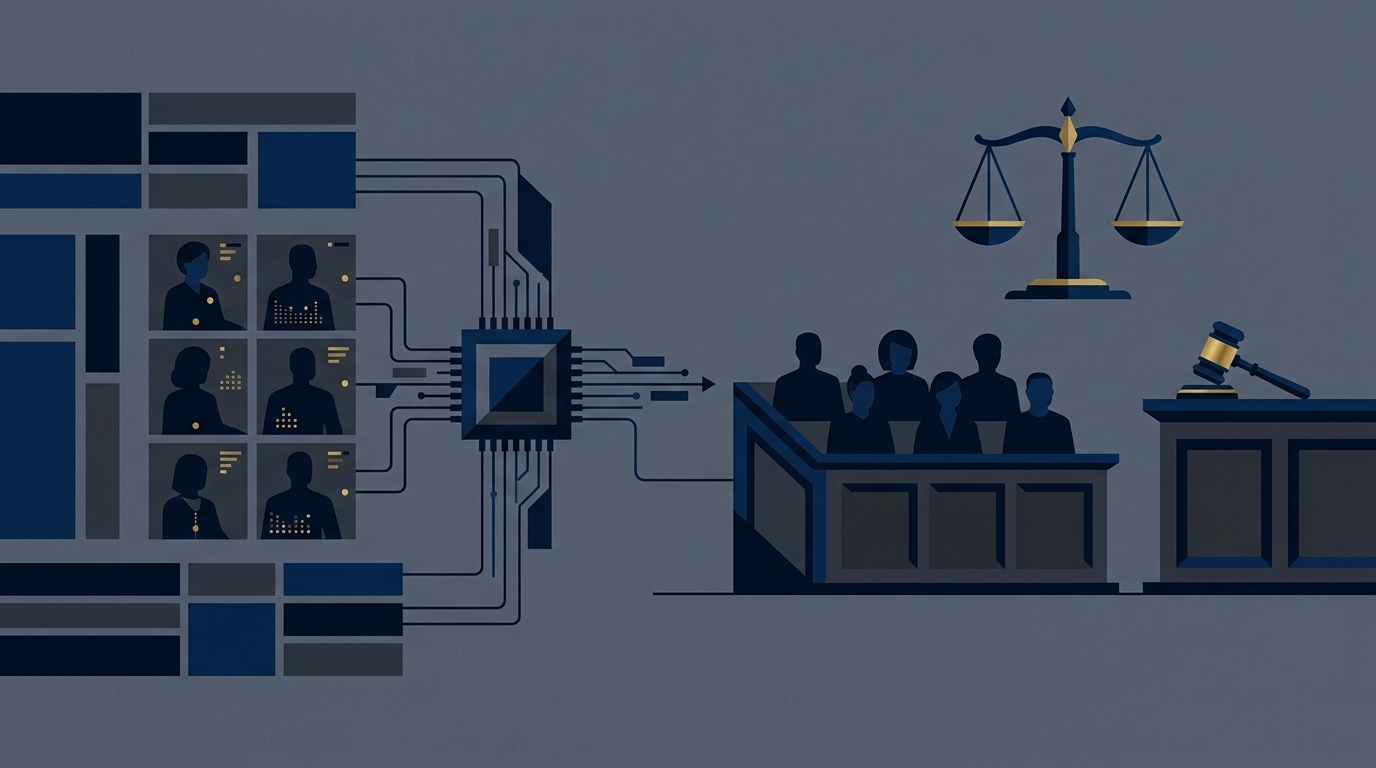
AI jury selection software is best understood as a structured decision-support system, not a reliable predictor of how individual jurors will vote. The most useful way to evaluate any such tool before purchase is to trace its actual workflow—questionnaire import, juror profile building, theme scoring, and follow-up flagging—and ask, at each stage, what the software is really doing versus what the marketing implies it is doing. Most platforms can accelerate data capture, organize voir dire, surface apparent risk factors, and rank jurors according to themes counsel defines. None of that replaces the lawyer's final judgment about credibility, group dynamics, cause challenges, and peremptories. Attorneys who understand this distinction going into a demo will ask sharper questions, avoid paying premium prices for glorified note-taking apps, and reduce the risk of building a strike record that looks statistically neutral but actually leans on proxies for protected characteristics. This post walks through the four-stage workflow common to most commercial products, distinguishes what AI can plausibly help with from what it cannot reliably establish, and closes with a concrete red-flags checklist for buyers—covering explainability, jurisdictional assumptions, data privacy, and the difference between automated note-taking and genuine predictive analysis.
The Actual Workflow Behind AI Jury Selection Software
Nearly every commercial AI jury selection product on the market follows some version of the same four-stage pipeline. Understanding each stage—and its limits—is the foundation for any serious buying decision.
Stage One: Questionnaire Import
The process begins with data ingestion. Counsel uploads juror cards or supplemental questionnaires, scans paper forms, imports a spreadsheet, or enters responses manually during a break. More sophisticated systems allow multipart questions that mirror the specific court's questionnaire format and support group-question tracking as voir dire unfolds in real time.
This is also where the first, and most underrated, buying question arises: is this software performing optical character recognition and searchable digital storage, or is it actually running validated analysis on the content? A product that turns a stack of paper questionnaires into searchable, tagged digital notes is genuinely useful for trial teams. But digitization is not the same thing as prediction, and vendors sometimes blur that line in sales conversations.
Stage Two: Juror Profile Building
Once data is captured, the system builds a composite profile combining questionnaire responses, live observations, seating position, hardship requests, cause issues, and answers given during oral questioning. Commercial marketing frequently touts juror profiles built from more than 150 data points, including imported questionnaire fields and demographic information.
This stage deserves the most scrutiny. Fields like zip code, occupation, education level, surname, primary language, and neighborhood are facially neutral but can function as proxies for race, ethnicity, or socioeconomic class. A 2026 legal analysis on AI in jury selection specifically warns that apparently neutral inputs can operate this way even without any explicit reference to a protected category. Any lawyer evaluating a tool should ask the vendor directly which fields are collected, why, and whether the vendor has tested for disparate impact across those fields.
Stage Three: Theme Scoring
This is the stage most vendors lead with in sales demos. Lawyers typically define case themes—trust in institutions, attitudes toward damages, corporate responsibility, personal-responsibility beliefs, skepticism of experts—and assign relative weights. The software then updates a running score for each juror as new information comes in. Products in this space advertise real-time rankings, color-coded seating charts, scenario modeling for cause challenges and peremptories, and shared scoring visible to the whole trial team.
It is worth stating plainly: a theme score is not an objective probability that a juror will favor one side. It is an output shaped entirely by which variables were selected, how they were weighted, and—in some products—training data the vendor has never disclosed. Even published research showing machine-learning models outperforming a professional jury consultant's baseline predictions involved a controlled comparison under identical, limited information conditions. That is a meaningful data point, but it is not proof that the same model performs reliably across different jurisdictions, judges, case types, or venires. Treat any score as one input among several, not a verdict-in-waiting.
Stage Four: Follow-Up Flagging
Finally, the system flags jurors for hardship, cause review, strike consideration, or additional questioning, and may generate suggested follow-up questions for an individual juror or the panel as a whole.
The flag should function as a prompt, never a conclusion. Counsel still has to determine whether an answer is genuinely ambiguous, whether probing further would expose real bias or simply annoy a nervous juror, and whether pursuing the line of questioning risks creating a record that looks worse than the underlying concern.
What AI Jury Selection Software Can and Cannot Tell Trial Lawyers
Given that workflow, it helps to separate realistic capabilities from claims that outrun the evidence.
What It Can Reasonably Help With
- Consistent organization of large, multi-page questionnaires across a full venire
- Flagging missing, inconsistent, or potentially significant responses that a tired trial team might miss at 8 a.m.
- Comparing jurors against case themes counsel has expressly defined, rather than themes baked in by the vendor
- Preserving contemporaneous notes and strike rationales—useful later if a Batson challenge is raised
- Giving the full trial team a shared, real-time view of panel composition and individual assessments
What It Cannot Reliably Establish
- Whether a specific juror will decide for or against a party
- Whether a facial expression reflects bias, confusion, fatigue, or simple discomfort in a courtroom setting
- Whether a juror is being candid rather than giving a socially desirable answer
- How individual jurors will behave once they are deliberating as a group
- Whether a statistical correlation drawn from other cases applies to this venue, this judge, this case, or this venire
- Whether a recommended strike is actually legally permissible under governing law
Why AI Jury Selection Software Cannot Replace Human Judgment on Strikes
Jury selection is not a purely statistical exercise—it is governed by constitutional and jurisdiction-specific rules that no algorithm can apply on its own. Batson v. Kentucky, 476 U.S. 79 (1986), prohibits race-based peremptory challenges, and the Supreme Court extended that principle to sex-based challenges in J.E.B. v. Alabama ex rel. T.B., 511 U.S. 127 (1994). A tool that ranks jurors using zip code, surname, or occupation as inputs can create a serious ethical and evidentiary problem even if the interface never displays race directly, because a disparate pattern in strikes can still trigger a Batson inquiry regardless of how the underlying score was generated.
This matters across practice areas, though the pressure points differ:
- Plaintiff's counsel in personal injury or mass tort cases often use theme scoring around damages attitudes and corporate accountability—but must guard against over-relying on demographic proxies when time is short during oral voir dire.
- Criminal defense attorneys face the added stakes of liberty interests and frequently more limited questionnaires; an opaque score with no explainable basis is especially risky when a client's freedom is on the line and appellate review may scrutinize strike rationales.
- Corporate defense teams handling complex commercial litigation may have the resources for the most data-heavy profiles, which raises the disparate-impact question in sharper relief given the volume of data points collected.
- Prosecutors operate under their own Batson exposure and public accountability expectations, meaning any AI-assisted strike recommendation needs a human-reviewable, articulable, race-neutral justification independent of the software's score.
Red Flags Before Buying AI Jury Selection Software
Before signing a contract, run any vendor through this checklist:
- No explainability. The vendor cannot identify which inputs drove a score, how they were weighted, what data trained the model, or what its confidence limits are.
- Jurisdictional overreach. The product assumes uniform rules for questionnaires, voir dire procedure, hardship excusals, juror numbering, or peremptory strikes—when these vary significantly by state and even by judge.
- Protected-class proxies. The vendor cannot explain how it prevents zip code, surname, language, or occupation from functioning as a stand-in for race, ethnicity, or class, and has never tested outputs for disparate impact.
- Marketing certainty. Claims like "identifies the best juror" or "predicts verdicts" with no disclosed error rate, no confidence interval, and no case-specific validation study.
- Note-taking disguised as prediction. The demo is heavy on OCR, seat maps, and searchable notes but light on any reproducible scoring methodology.
- Weak privacy terms. The contract is silent on encryption, data retention, deletion timelines, vendor access, breach notification, subcontractor use, whether client data trains the vendor's model, and export rights at the close of the matter.
- No audit trail. Counsel cannot later reconstruct what information produced a given score or preserve the human rationale behind a challenge—a real problem if a Batson objection surfaces post-trial.
- Automation of legal judgment. The system suggests or executes strike recommendations without requiring a lawyer's jurisdiction-specific review and sign-off.
The safest procurement standard is to treat any AI jury selection tool as a high-speed courtroom notebook with optional analytics, unless the vendor can affirmatively demonstrate more—through transparent methods, representative validation, real privacy protections, and workflow controls that keep the lawyer's judgment final at every step.
FAQ
Does AI jury selection software predict how a juror will vote? No credible product can reliably predict an individual juror's vote. At most, these tools generate a theme score based on lawyer-defined criteria and available data, which is a structured input for counsel's judgment, not a verdict forecast.
Can using AI in jury selection create a Batson problem? Yes, potentially. If a tool's inputs include proxies for race or sex—such as zip code, surname, or neighborhood—and strikes correlate with those proxies, the pattern can support a Batson v. Kentucky or J.E.B. v. Alabama challenge even if the software never explicitly considers a protected characteristic.
What's the difference between digital note-taking and real predictive analytics in this space? Digital note-taking software digitizes and organizes questionnaire responses and observations—useful, but not analytical. Genuine predictive analytics involves a disclosed methodology, defined weighting of variables, and ideally some form of validation testing. Many products blend both, so buyers should ask vendors to clearly separate the two functions.
Should smaller firms or solo practitioners use AI jury selection tools? It depends on the case type, budget, and available support during trial. These tools can help a smaller team keep pace with questionnaire volume and organize voir dire notes, but the same caution about explainability, jurisdictional fit, and privacy applies regardless of firm size.
How should attorneys document their use of AI-assisted jury selection? Maintain a clear, contemporaneous record of the human reasoning behind each strike or cause challenge, independent of any software-generated score. This protects the record if a Batson-type challenge is raised and ensures the final decision reflects legal judgment rather than an unexplained algorithmic output.
A Practical Starting Point
None of this means AI has no place in jury selection—it means the technology should be evaluated with the same rigor trial lawyers apply to any other piece of trial evidence: sourced, tested, and never taken at face value. At StrikeList AI, the goal has been to build tools around that same principle—supporting organization, theme tracking, and team collaboration during voir dire while leaving the final call on any strike squarely with counsel. Whatever platform a firm ultimately chooses, the workflow and red-flags framework above should make the evaluation process considerably more concrete.
See how StrikeList AI fits your next trial.
Buy a single trial and start today, or request a short demo to see the workflow on a real panel.