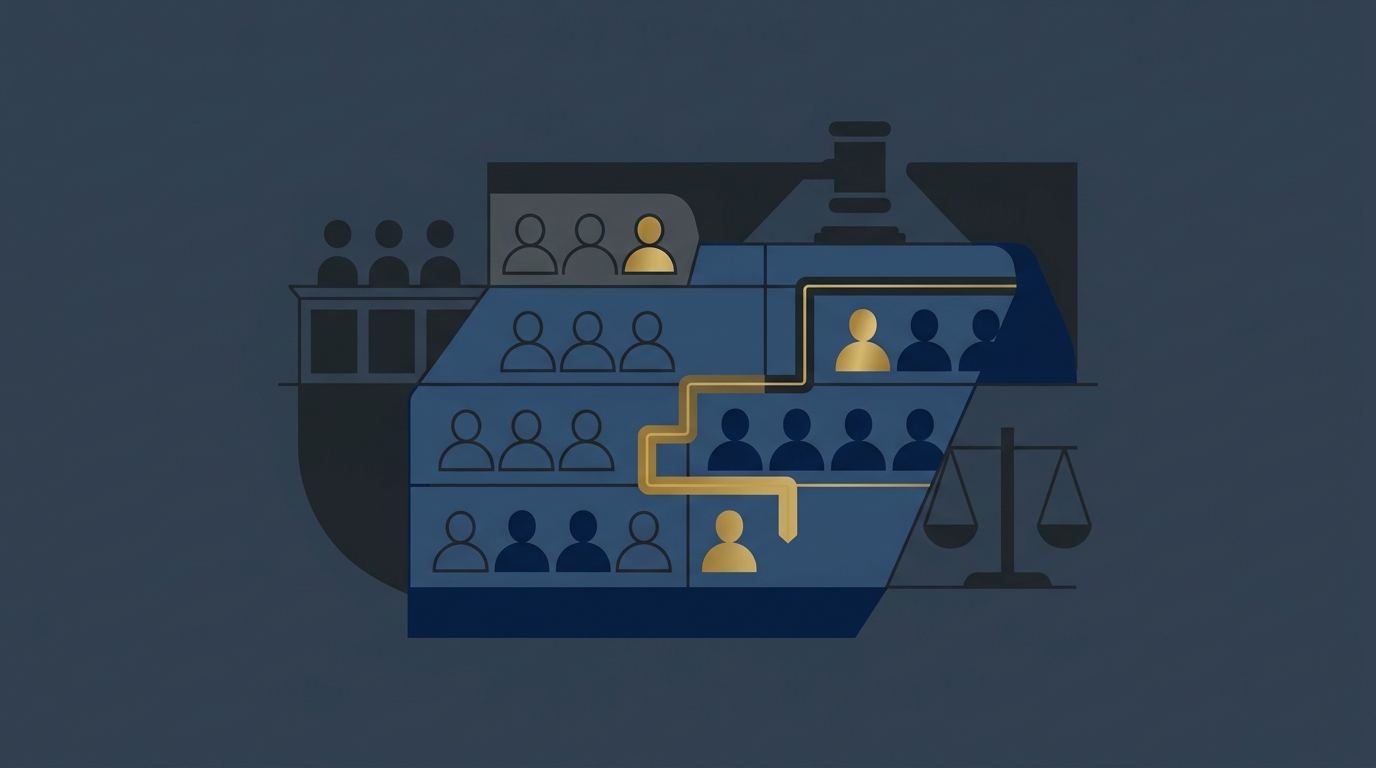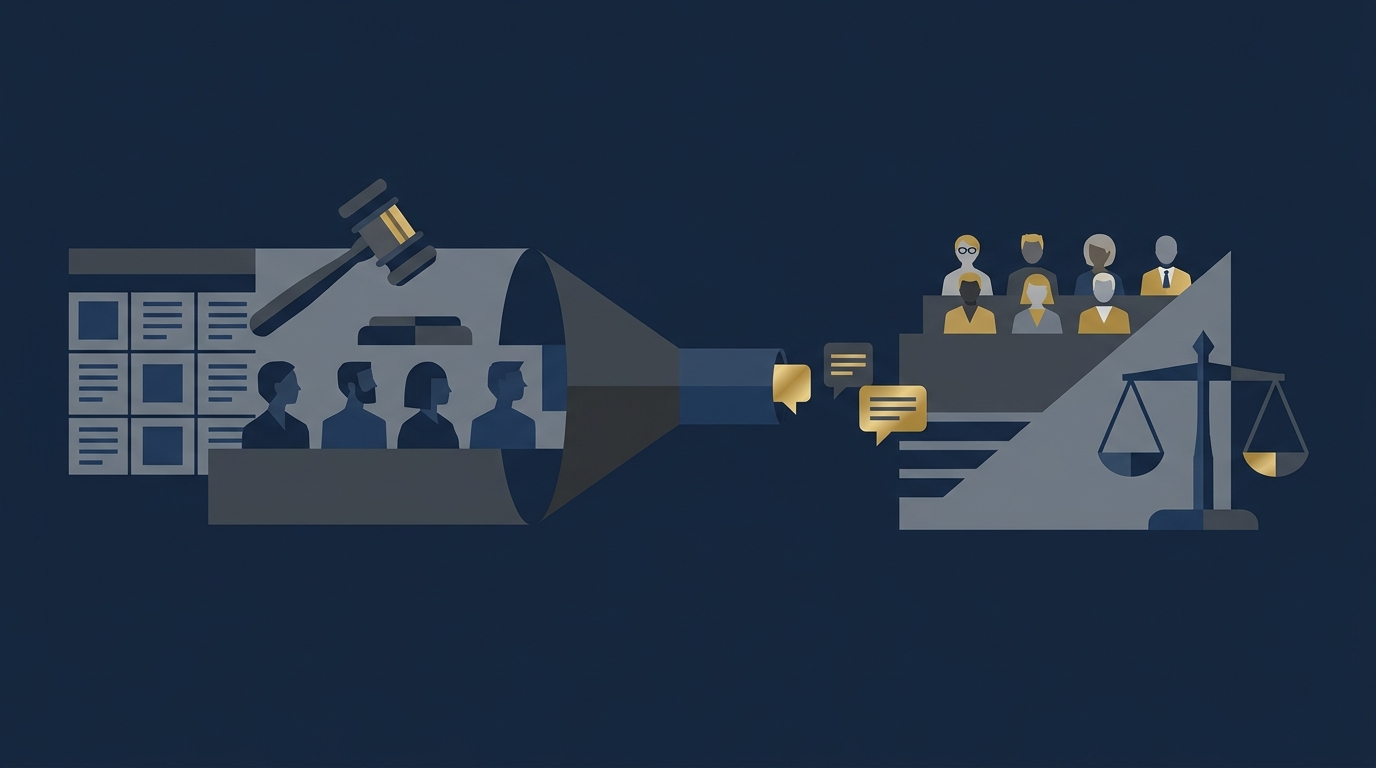
A juror questionnaire is not a paper version of voir dire. It is a screening and issue-spotting instrument, and treating it otherwise is the most common drafting mistake trial lawyers make. The practical rule: reserve written space for facts likely to reveal disqualification, case-specific bias, undisclosed relationships, or serious hardship. Leave nuanced credibility testing, hypotheticals, and ambiguous attitude questions for oral follow-up, where tone, hesitation, and clarification can actually do their work.
That distinction matters because questionnaire space is almost always limited — courts cap page counts, lawyers compete for approved questions, and jurors lose patience with redundant items. Every question you include should be one that could not be asked as effectively, or as candidly, in open court.
Why Questionnaire Space Is a Scarce Resource
Courts allow written questionnaires because they are efficient at gathering sensitive background information before a venire panel is seated — pretrial publicity exposure, relationships, relevant life experience, and fixed opinions can be identified without forcing jurors to disclose personal details in front of strangers. Federal courts have long recognized this efficiency, particularly in complex, high-profile, or emotionally charged cases.
But the governing standard for how much latitude counsel gets is local, not universal. In federal criminal cases, Federal Rule of Criminal Procedure 24 lets the court conduct voir dire itself and, at its discretion, permit counsel to submit additional questions or supplement the examination directly. The method of voir dire is generally treated as committed to the trial judge's sound discretion. That means the same proposed questionnaire that sails through in one courtroom may get trimmed by half in another, and lawyers who draft generic, exhaustive questionnaires without accounting for the judge's preferences often lose their best questions to the editing room floor.
There is also an unresolved procedural issue worth tracking: a recent Supreme Court docket filing highlights disagreement over whether a court may excuse a juror for cause based solely on written questionnaire answers, without any in-court voir dire to confirm or probe the response. Until that question is resolved uniformly, the safer drafting posture is to treat the questionnaire as an information-gathering tool that supports oral follow-up and cause challenges — not as a substitute for the court's required oral examination.
Juror Questionnaire Questions That Usually Earn Their Place
Case-Specific Experience
Prior experience deserves space when it bears directly on an element of the claim, a defense theory, a witness category, or a likely emotional theme at trial. In a products liability case, that might mean asking whether the juror or a close family member has worked in manufacturing, engineering, or quality control. In a criminal case involving digital evidence, it might mean asking about prior work in cybersecurity or IT forensics.
Useful formulations include:
- Have you, a close family member, or a close friend been a victim, defendant, claimant, or witness in a similar case?
- Have you worked in law enforcement, health care, finance, construction, cybersecurity, or another field central to the evidence in this case?
- Have you participated in an investigation, audit, internal complaint, regulatory proceeding, or insurance claim involving similar facts?
Ask for a brief explanation and an approximate date. The goal is not a biography — it is identifying experiences that could color how a juror interprets evidence or applies a legal standard they've encountered before, informally or professionally.
Relationships and Institutional Connections
Relationship questions are consistently high-value because they surface actual or implied partiality that general attitude questions miss entirely, and they give counsel a concrete anchor for oral follow-up. Ask about contact with:
- Parties, counsel, witnesses, experts, investigators, insurers, employers, agencies, or their affiliates
- The courthouse, prosecution office, police department, hospital, corporation, or university involved in the case
- Organizations likely to function as a factual or moral reference point during trial (a union, a professional licensing board, a faith community central to the facts)
A plaintiff's lawyer in a medical malpractice case wants to know if a juror's primary care physician trained at the defendant hospital. A corporate defense team wants to know if a juror's former employer sued or was sued by the plaintiff company. These are facts jurors may not volunteer unprompted in open court, which is exactly why they belong on paper.
Media Exposure and Prior Opinions
In a high-profile case — a prosecution with significant local coverage, a corporate defendant already facing public scrutiny, a plaintiff's case tied to a widely reported incident — questionnaires should probe exposure with more precision than a single fairness question. Ask:
- What have you read, watched, heard, or discussed about this matter?
- When did you encounter it, and how frequently?
- Did you form an opinion about the parties, the likely facts, or the probable outcome?
- Can you set aside what you encountered and decide solely on the evidence admitted at trial and the court's instructions?
Avoid stopping at "can you be fair." That question invites a reflexive yes. The questionnaire should instead elicit source, intensity, repetition, and the apparent effect of exposure. Federal courts have used written questionnaires effectively to address publicity and prejudgment, but answers suggesting a fixed belief should ordinarily be explored orally before counsel moves for a challenge for cause — written answers alone rarely give a judge enough to rule on confidently.
Hardship and Ability to Serve
Hardship questions earn space when trial length, sequestration, language access, caregiving responsibilities, medical needs, employment, or financial pressure are genuinely material to the case. The key drafting discipline is asking for facts, not conclusions:
- What dates or obligations would make service difficult for you?
- Would service create a serious medical, caregiving, employment, or financial problem?
- Is the difficulty temporary, and could a scheduling or logistical accommodation address it?
A questionnaire that simply asks "would jury service be a hardship for you?" invites generalized inconvenience claims from jurors who would rather not serve. Courts need enough specificity to evaluate hardship consistently across the panel, and counsel needs enough detail to request targeted follow-up rather than accepting a vague excusal request at face value.
Bias and Implicit-Bias Follow-Ups
Bias questions should be concrete, neutral in tone, and tied to the evidence the jury will actually hear — not abstract tests of character. A useful model asks whether differences in race, ethnicity, religion, gender, age, disability, socioeconomic background, occupation, or appearance could make impartial decision-making difficult in this case, followed by: please explain. The New Jersey courts' model juror questionnaire expressly addresses both explicit and implicit bias and requests a written explanation rather than a yes-or-no answer.
It also helps to ask whether the juror can monitor automatic assumptions and commit to deciding based on evidence rather than first impressions or stereotype. This phrasing tends to be more productive than directly asking "do you have any bias," because most respondents will answer no reflexively and the question yields nothing useful for follow-up. A question that normalizes the existence of automatic associations — and asks how the juror manages them — produces more honest, more usable answers.
Questions Better Reserved for Oral Voir Dire
Not every bias-adjacent or attitudinal question belongs on paper. Reserve oral examination for:
- Vague answers such as "I dislike lawsuits" or "I distrust police," which require tone and follow-up to interpret
- Hypothetical verdict questions, which risk improperly committing a juror before evidence is presented
- Nuanced views about damages, punishment, expert testimony, or witness credibility
- Testing whether a claimed hardship is genuine and remediable through scheduling
- Exploring apparent contradictions between two questionnaire answers
- Asking a juror to articulate how a stated belief would actually affect deliberation
- Sensitive matters where a written record might unnecessarily expose personal information to the full venire or later become part of a public case file
Well-designed questionnaires use branching logic wherever the jurisdiction's procedures allow it: a short, neutral screening question, followed by a request for detail only if the juror answers affirmatively. This keeps the written instrument efficient while still flagging issues for oral development.
A Practical Prioritization Test for Juror Questionnaire Questions
Before including any question in a juror questionnaire, run it through five tests:
- Could the answer support a challenge for cause, a peremptory decision, a hardship request, or targeted oral follow-up?
- Is the information difficult for a juror to disclose candidly in open court, in front of the full panel?
- Is the issue likely to arise from this specific case's facts, witnesses, publicity, or anticipated trial length?
- Can the court evaluate the answer without demanding unnecessary personal detail from the juror?
- Would an oral answer be materially better — clearer, more complete, more honest — than a written one?
If the answer is no to most of these, the question should be cut. A short questionnaire with actionable answers consistently outperforms an exhaustive demographic inventory, both for counsel building a strike strategy and for a judge trying to move the panel efficiently. Confidentiality is part of this calculus too: courts may redact names, addresses, phone numbers, Social Security numbers, driver's-license numbers, and employer information before disclosing questionnaires to the parties, so drafting should account for what will realistically be visible to opposing counsel.
Perspective Differences Across Case Types
Plaintiff's counsel in a civil case typically prioritizes relationship questions tied to insurers, corporate defendants, and prior claims experience, along with attitude questions about damages — though the damages nuance itself should wait for oral follow-up rather than a written scale.
Criminal defense counsel often weighs law enforcement relationships and media exposure most heavily, particularly in cases with any pretrial publicity, and benefits from hardship questions that surface scheduling conflicts early, before those conflicts become disruptive mid-trial.
Corporate defense teams tend to focus questionnaire space on institutional relationships — prior litigation against the industry, regulatory experience, and employment history in competing or related businesses — since these connections are the ones jurors are least likely to volunteer unprompted.
Prosecutors frequently prioritize law enforcement relationships, victim-experience questions, and media exposure screening, while reserving punishment-related attitudes for oral examination, where tone and hesitation carry real diagnostic weight.
Across all four perspectives, the discipline is the same: match the question to what paper does well, and leave what paper does poorly for the courtroom.
FAQ
How long should a juror questionnaire be? There is no universal page limit; it depends on the jurisdiction, the judge, and the complexity of the case. The practical guidance is to include only questions that pass the five-part prioritization test above — a shorter questionnaire with actionable, specific answers is generally more useful than a long one built around generic demographic or attitude items.
Can a judge excuse a juror for cause based solely on questionnaire answers? Practice varies, and the issue remains unsettled in some respects — a recent Supreme Court docket filing highlights disagreement over whether written answers alone, without in-court voir dire, can support a for-cause excusal. Given that uncertainty, questionnaires are safer drafted as tools that support and trigger oral follow-up rather than as standalone grounds for excusal.
Should implicit bias questions ask jurors directly whether they are biased? Direct yes-or-no bias questions tend to produce reflexive denials and little usable information. A more productive approach asks whether specific differences — race, ethnicity, religion, gender, age, disability, socioeconomic background, occupation, or appearance — could make impartial decision-making difficult in this case, paired with a request to explain, and asks whether the juror can monitor automatic assumptions during deliberation.
What should be left out of a juror questionnaire entirely? Hypothetical verdict questions, detailed damages or punishment scales, and open-ended credibility assessments are generally better handled through oral voir dire, where follow-up and tone can clarify an ambiguous or vague written answer.
Does federal law require a juror questionnaire in every case? No. Federal Rule of Criminal Procedure 24 gives the trial court discretion over whether and how to conduct voir dire, including whether to permit a written questionnaire and how much supplemental questioning counsel may submit. The decision to use a questionnaire, and its scope, rests with the trial judge.
Building a Questionnaire That Earns Its Space
The through-line across case-specific experience, relationships, media exposure, hardship, and bias follow-ups is that each category asks the questionnaire to do something paper does well: gather facts jurors might hesitate to volunteer aloud, flag issues before the panel is seated, and create a documented basis for later follow-up or challenge. Everything else — the hypotheticals, the credibility tests, the ambiguous attitude probes — belongs in the courtroom, where a lawyer can actually watch a juror answer.
Lawyers who track which categories of questions have produced useful strikes or cause challenges across past trials tend to refine their questionnaires faster than those starting from a blank template each time. That kind of pattern recognition — across case types, jurisdictions, and juror responses — is part of what we built StrikeList AI to support: helping trial teams organize and learn from questionnaire and voir dire data so each new questionnaire starts from an informed baseline rather than a guess.
See how StrikeList AI fits your next trial.
Buy a single trial and start today, or request a short demo to see the workflow on a real panel.