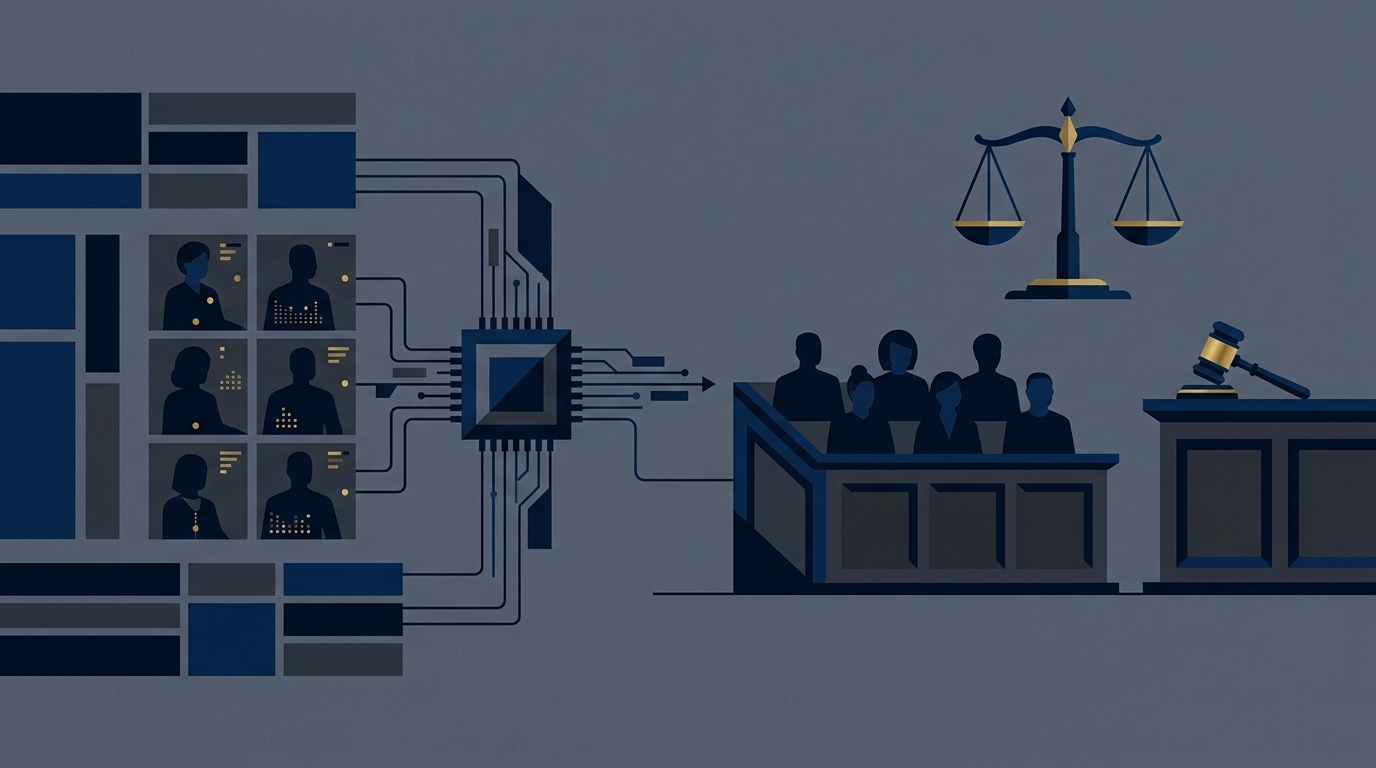
If you are evaluating AI jury selection software, the question is not whether the vendor's marketing claims sound credible. The question is whether you can verify those claims before you rely on the tool in a real case. The answer is a five-part pre-purchase protocol: test the software on a representative mock panel, require a documented source trail for every juror-level recommendation, confirm the tool distinguishes fact from inference, measure how fast it updates during simulated voir dire, and preserve a procurement audit file that shows your validation work. Treat AI jury selection software as a decision-support product, not an authority on whom to strike. The lawyer, not the vendor, remains responsible for every peremptory challenge and every cause challenge made in open court.
This guide walks through that protocol step by step, with attention to how the calculus differs across plaintiff's work, criminal defense, corporate defense, and prosecution.
The Governing Legal Baseline for AI Jury Selection Software
Before testing any product, counsel needs to know the rules the tool must operate within.
Discrimination law applies regardless of how the strike was generated. Batson v. Kentucky, 476 U.S. 79 (1986) prohibits race-based peremptory strikes, and J.E.B. v. North Carolina, 511 U.S. 127 (1994) extends that prohibition to sex-based strikes. A facially neutral algorithm does not cure discriminatory use of proxies such as ZIP code, surname, language, occupation, or social media behavior. If a tool's recommendation correlates heavily with a protected characteristic, the fact that the software never "saw" race or sex as an input field will not insulate the strike from a Batson challenge.
Competence and confidentiality obligations travel with the tool. Under Model Rule 1.1, including its technology-competence commentary, lawyers must understand the benefits and risks of the tools they use in practice. Model Rule 1.6 requires protection of client and case information, which matters directly when a vendor is scraping or storing juror data. ABA Formal Opinion 512 addresses generative AI specifically and states that lawyers remain responsible for competence, confidentiality, supervision, candor, and reasonable fees when using AI tools, and it emphasizes independently verifying AI output rather than accepting it at face value.
Put plainly: a recommendation that cannot be explained to opposing counsel or the court is not a defensible reason for a strike. That single sentence should govern every procurement decision you make.
Five-Step Protocol for AI Jury Selection Software Evaluation
1. Test a Fixed Sample Panel Before You Buy
Do not evaluate a tool on a vendor-curated demo. Require the vendor to process a panel you construct, containing:
- Jurors with deliberately varied race, sex, age, geography, occupation, education, and socioeconomic indicators
- Duplicate or near-duplicate profiles that differ in only one attribute
- Incomplete, conflicting, stale, and misleading data
- Jurors whose public records contain identical facts but different names or ZIP codes
Record the rankings, scores, recommended questions, confidence levels, and processing time. Then repeat the test after changing only potentially protected attributes or their proxies. If outputs change materially when you swap a surname or ZIP code while holding everything else constant, that is a signal the tool may be encoding discriminatory proxies, and the vendor owes you a documented explanation before you proceed.
Do not accept a single headline accuracy percentage as proof of reliability. Ask for the test population, the outcome definition, the base rate, false-positive and false-negative rates, calibration, confidence intervals, and performance broken out by demographic group. Published jury-selection research has reported model accuracy figures as high as 82.91% for a Random Forest experiment, but figures like that are dataset-specific and do not establish courtroom reliability on your case's venire.
2. Demand a Source Trail for Every Material Assertion
For each juror-level recommendation, require the vendor's platform to show:
- The underlying source, retrieval date, and relevant excerpt
- Whether the source was public, licensed, user-supplied, or inferred
- A clear label distinguishing fact, vendor-generated inference, and prediction
- The model or rules used, including version number and applicable data window
- An export function for the complete record
This is the step most buyers skip, and it is the one most likely to matter in a post-trial challenge. A line that reads "likely distrusts corporate defendants" is not equivalent to a verified fact about that juror's litigation history. If a tool collapses uncertain inference into confident-sounding factual language, with no visible label separating the two, reject it. You cannot articulate a race-neutral, gender-neutral explanation for a strike in court if you cannot tell your own software's guesses from its sourced facts.
3. Test Explainability and Challengeability Directly
Hand the tool to a trial lawyer who has never used it and ask that person to explain, in plain language, why the system ranked five sample jurors the way it did. A usable explanation identifies which inputs mattered most, discloses what information was missing or unavailable, and allows counterfactual testing: what happens to the ranking if one input is removed?
Separately, ask the vendor directly whether the system uses or derives race, sex, religion, disability, political affiliation, or other sensitive attributes, even indirectly. Proxy discrimination remains a live concern even when protected fields are formally excluded from the input schema, because facially neutral variables like neighborhood, club membership, or consumer data can still encode discriminatory signal. If the vendor cannot answer this question with specificity, that is itself an answer.
4. Simulate Live Voir Dire Conditions
Marketing materials describe analysis speed in the abstract. You need to measure it under conditions that resemble your actual courtroom day. Run a timed exercise in which new questionnaire answers and oral voir dire notes arrive in batches, as they would during jury selection, and measure:
- Time from input to updated recommendation
- Whether earlier scores recalculate consistently once new information arrives
- Whether the tool preserves version history as inputs change
- How the system handles contradictory or deleted information
- Whether counsel can override, annotate, and export results without losing the audit trail
A tool that only updates overnight is not a live voir dire product, no matter how sophisticated its underlying model is. Before signing, get contractual language defining uptime, update latency, correction procedures, incident reporting, and support availability during trial itself — not just during onboarding.
5. Audit Privacy, Security, and Retention Before Any Real Data Goes In
Obtain written terms addressing encryption, access controls, subcontractors, whether your data trains the vendor's model, data ownership, deletion timelines, subpoena response procedures, breach notification, and retention periods. Use synthetic or de-identified data for your evaluation until these confidentiality questions are resolved in writing. ABA guidance recommends exactly this kind of due diligence concerning a vendor's privacy practices, data retention, confidentiality protections, and contract terms before adopting an AI tool in practice.
Perspective Check: How the Stakes Shift by Practice Area
Plaintiff's counsel in personal injury or employment cases often use jury analytics to gauge damages receptivity and anti-corporate sentiment. The proxy-discrimination risk is real here too — reptile-theory-adjacent scoring that correlates heavily with occupation or neighborhood can functionally sort jurors along racial or socioeconomic lines even without intending to.
Criminal defense counsel face the highest stakes for explainability, because a client's liberty is on the line and a Batson objection sustained against the defense can taint the entire strike pattern. A defense team should be especially rigorous about Step 3's counterfactual testing before relying on any ranking that disfavors jurors from particular communities.
Corporate defense counsel frequently operate under institutional data-governance policies that make Step 5's privacy audit non-negotiable; outside counsel using an unvetted tool on a public company's behalf can create exposure well beyond the courtroom.
Prosecutors operate under disclosure and public-trust constraints that make an undocumented, opaque algorithmic recommendation particularly risky — an office that cannot explain its jury selection methodology if challenged faces institutional consequences beyond a single case.
Across all four perspectives, the common thread is the same: the tool's output is a starting hypothesis for further investigation, not a substitute for the lawyer's own judgment and record-supported reasoning.
Building the Procurement Decision File
Before you ever use a tool in a live case, assemble and preserve: the vendor's methodology disclosures, your test dataset, the tool's outputs on that dataset, your error analysis, your proxy-discrimination testing from Step 1, the source records reviewed in Step 2, version information, the signed contract terms from Step 5, and a short written memo of your own validation conclusions. This file does two things. It gives you a defensible record if a strike is later challenged, and it gives your firm a repeatable standard the next time you evaluate a competing product or a new version of the same one.
Before relying on any recommendation in trial, independently verify the underlying facts and be prepared to articulate a conventional, lawful, record-supported reason for every challenge you exercise — the same standard that applied before any software was involved.
FAQ: AI Jury Selection Software
Does using AI jury selection software create Batson exposure even if the tool never uses race as an input? Yes, potentially. Batson and its progeny look at the discriminatory effect and pattern of strikes, not just the stated input fields of the tool that generated a recommendation. If a facially neutral variable like ZIP code or surname functions as a proxy for race or sex, a pattern of strikes following the tool's recommendations can still support a Batson challenge.
What accuracy threshold should a buyer require before adopting a tool? There is no single accepted threshold, and a headline accuracy percentage from a vendor's internal study is not sufficient on its own. Buyers should instead request the test population, base rate, false-positive and false-negative rates, and performance broken out across demographic subgroups, since a tool can show strong aggregate accuracy while performing unevenly across groups.
Can a lawyer rely entirely on a tool's ranking when deciding whom to strike? No. Under Model Rule 1.1 and guidance such as ABA Formal Opinion 512, the lawyer retains responsibility for independently verifying output and exercising professional judgment. The tool's ranking can inform the decision, but the lawyer must still be able to articulate a lawful, non-discriminatory, case-specific reason if the strike is challenged.
How fast does a tool need to update to be usable during live voir dire? There is no fixed industry standard, but a tool that only refreshes recommendations overnight cannot support real-time decisions as jurors answer questions in the courtroom. Buyers should contractually define acceptable update latency and test it under simulated conditions before relying on the product at trial.
What should a firm do with juror data after a case concludes? Firms should obtain written vendor terms covering data retention and deletion before adopting any tool, and should confirm whether juror data is deleted, anonymized, or retained for vendor model training after a case closes, consistent with confidentiality obligations under Model Rule 1.6.
A Closing Note on Procurement, Not Persuasion
None of this protocol is about finding a flawless tool — no analytics product, human or algorithmic, will eliminate uncertainty from jury selection. The goal is narrower and more achievable: a documented process that lets you explain, to a judge or to your own supervising partner, exactly why you trusted a particular recommendation on a particular day. That is the standard tools like StrikeList AI are built to support — giving trial teams a structured way to organize juror research, surface it with clear sourcing, and keep an audit trail alongside the lawyer's own independent judgment, rather than asking counsel to take a black box at its word.
See how StrikeList AI fits your next trial.
Buy a single trial and start today, or request a short demo to see the workflow on a real panel.