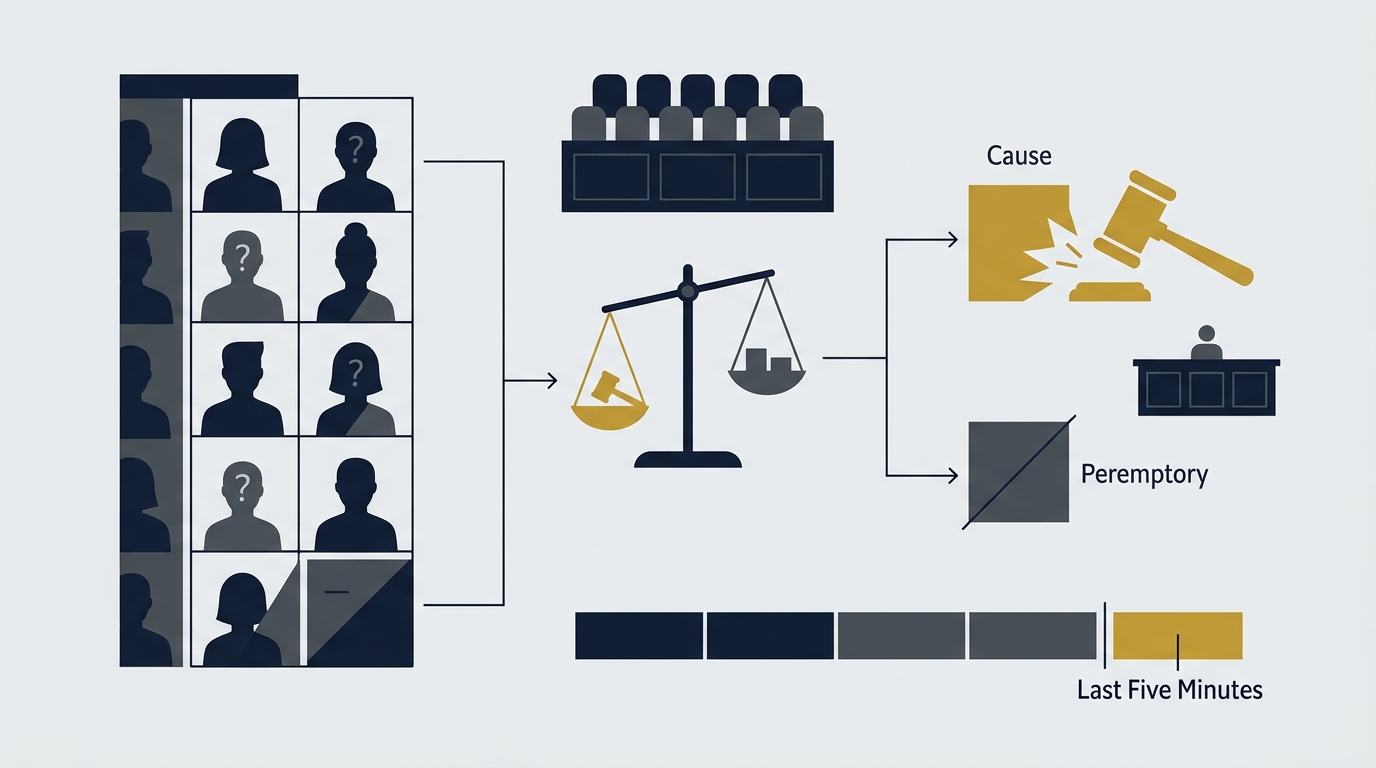
A juror gives you an answer that's not clean enough to win a cause challenge but not vague enough to ignore. The judge is already looking at the clock. You have maybe five minutes before the panel moves on, and you have to decide: push for cause, burn a peremptory, or let it go. The direct answer is this: score the problem on legal sufficiency and record clarity, weigh it against how many strikes you have left and how bad the next juror might be, then act. If legal sufficiency plus record clarity is strong and the juror can't be rehabilitated, go for cause and get a ruling. If the concern is real but the record is thin, spend the strike. If your strikes are gone and the replacement juror looks worse, you may need to accept the one you have.
That sounds simple written out. It is not simple standing at the podium with thirty seconds of follow-up left. The rest of this piece is a working matrix to make that decision faster and more defensible, no matter which side of the room you're sitting on.
Why the last five minutes are different
Most voir dire training focuses on building a cause record over an extended exchange: open-ended questions, follow-up, a slow narrowing toward the legal standard. That approach works when you have time. It does not work when a juror drops a concerning answer during general questioning of the panel and the court is ready to move to the next topic, or when you're on strike number four with three panels left to seat.
In that moment, lawyers on every side of the case make the same mistake: they either freeze and let the moment pass, or they spend a peremptory reflexively on anything that sounds bad. Neither is a strategy. What you need is triage, not another cause hearing.
A five-factor triage score for voir dire
Rate each factor from 0 to 2 as the juror is answering, or within seconds of the answer closing.
| Factor | 0 | 1 | 2 |
|---|---|---|---|
| Legal sufficiency | Mere preference or discomfort | Potential statutory or common-law concern | Articulated bias, disqualification, or inability to follow law |
| Record clarity | Vague or isolated answer | Ambiguous answer with some supporting facts | Clear, unequivocal, transcribed admission |
| Rehabilitation likelihood | Juror readily accepts a neutral rule | Qualified or equivocal acceptance | Retraction appears tactical, inconsistent, or implausible |
| Remaining peremptories | Ample strikes remain | Limited reserve | No meaningful reserve |
| Replacement risk | Next juror appears materially worse | Comparable uncertainty | Replacement is likely more harmful |
Add the scores. The decision rule:
Cause first when legal sufficiency plus record clarity totals at least 3, and rehabilitation likelihood is low. In that scenario, ask one focused follow-up question, state the governing ground out loud, and request a ruling before the panel moves on. Don't let the moment pass without a ruling on the record, favorable or not.
Peremptory first when the concern is real but legally insufficient, the record is muddled, or the juror seems likely to get rehabilitated with one more question from the judge.
Accept or defer when replacement risk is high and the concern rests only on a generalized impression, not a specific statement.
The last two factors, remaining strikes and replacement risk, matter, but they are a counterweight, not a substitute for the legal analysis. A strong cause challenge should not get abandoned just because you're down to your last two strikes. A weak cause motion, on the other hand, should not consume your last peremptory when the juror sitting behind the one you're worried about is predictably worse for your case.
Cause or peremptory: the legal dividing line
Cause challenges target partiality, incompetence, statutory disqualification, or an inability to apply the law as instructed.[7][8] Peremptories exist for the juror who seems unfavorable to your case but doesn't meet that legal threshold. Minnesota's Supreme Court has described the peremptory challenge as the appropriate tool when fairness is legitimately in doubt but the doubt doesn't rise to the level required for cause.[10]
This distinction is where the cause-or-peremptory decision actually gets made. A juror who says "I'd try to be fair, but it would be hard" is a peremptory candidate in most courtrooms. A juror who says "I could not set that aside no matter what the evidence showed" is a cause candidate, assuming the record captures that statement cleanly.
The federal rule is unforgiving once you've made the call
Under Ross v. Oklahoma, and as reflected in later federal decisions, using a peremptory to remove a juror after a denied cause challenge ordinarily does not establish constitutional error, so long as no biased juror ultimately sat on the panel. The Fifth Circuit has called this the "hard choice": use the peremptory on the juror you're worried about, or leave a potentially biased juror seated and hope the panel is still fair.[9] That rule is why the contemporaneous record matters so much. If a denied cause motion forces you to spend a strike and that cost later means you can't remove a different problem juror, the record of that chain of events is what preserves the issue. Without it, the appellate court has nothing to review.
State law can give you more room
Jurisdiction changes the calculus. In State v. Newcomb, the West Virginia Supreme Court held that a clear statement of disqualifying prejudice could not be rehabilitated later by general promises of fairness, and that preserving the defendant's full peremptory allotment mattered to the analysis.[4] In Ries v. State, the Minnesota Supreme Court held that failing to use a peremptory strike did not automatically forfeit appellate review of a denied cause challenge.[1] If you practice in a jurisdiction with protections like these, the value of fighting for cause, even on a borderline record, goes up, because a denial doesn't necessarily force you to spend your last strike just to preserve the point.
Know your jurisdiction's rule before trial starts. The triage score above assumes a baseline where strikes are scarce and precious. If your court gives more latitude on preservation, you can weight legal sufficiency more heavily and worry less about strike scarcity.
The last-minute script
When the clock is actually running, use a compressed sequence instead of an open-ended rehabilitation exchange:
- Pin down the proposition. "Are you saying you could not set that view aside if the evidence proved otherwise?" This forces a yes or no on the record instead of a paragraph of hedging.
- Test the legal standard. "Could you follow the court's instruction even if you disagree with it?" This ties the answer directly to the legal ground for cause.
- Expose inconsistency. Ask whether the juror's answer is a firm limitation or just a concern they'd work through. The distinction between those two is often the whole case.
- Seek a ruling. State the specific cause ground out loud and ask the court to rule. Don't let the panel move on without one.
- Protect the alternative. If cause is denied, exercise the peremptory only after you've put the objection, the juror's seat number, and the remaining-strike consequence on the record.
Resist the urge to ask open-ended rehabilitation questions like "can you be fair?" That question invites a reflexive "yes" that gives the court an easy basis to call the juror cured, and it does nothing for your record. A short, rule-linked question that forces a specific answer is worth more than a long exchange that lets the juror talk their way back to neutral.
Applying the matrix from each seat at the table
Plaintiff's counsel in a civil case often faces this exact scenario with a juror who signals skepticism about damages, not about liability. That skepticism rarely clears the bar for cause on its own. Score it: legal sufficiency is usually low (a preference about damages amounts, not an inability to follow instructions), so the matrix typically points toward peremptory, assuming you have strikes left and the next juror in the box isn't worse on the same issue.
Criminal defense counsel sees this most often with jurors who express discomfort with a presumption of innocence or law enforcement credibility. If the juror's language tracks disqualifying bias (an inability to presume innocence, not mere discomfort with it), legal sufficiency and record clarity both score high, and that combination should push toward a cause fight even with few strikes remaining, because the stakes of seating a biased juror in a criminal case are different from a civil damages dispute.
Corporate defense counsel frequently triages jurors with strong personal experiences (a bad outcome with the defendant company's industry, a prior lawsuit) that create sympathy risk without a clean legal hook. These usually land in the peremptory-first category unless the juror makes a specific, on-the-record statement tying that experience to an inability to be fair to the corporate party.
Prosecutors confront the mirror image of the criminal defense scenario: jurors who state they could never convict based on certain kinds of evidence, or who express views that track jury nullification sentiment. When that sentiment is stated as an absolute, not a preference, it should score high on legal sufficiency and record clarity, and a cause motion is usually worth pursuing even late in the process.
In every one of these postures, the scoring exercise is the same. What changes is which factor typically dominates, because the legal standard for cause and the practical risk of an unfavorable juror shift with the type of case and the party's role in it.
The record is the point, even when you lose
The immediate goal in the last five minutes is seating an impartial jury. The appellate goal, if it comes to that, is a transcript that shows exactly why you were forced into a hard choice. Those two goals don't always point the same direction in the moment, and that's fine. Use cause when the juror's own words establish an inability to follow the law, a disqualification, or a fixed bias. Use a peremptory when the concern is predictive rather than something you can point to in the transcript. Preserve both arguments where your jurisdiction allows it, but don't mistake preservation for winning. A denied cause motion followed by a well-documented peremptory is not a loss if the record is clean. An abandoned cause argument with no ruling on file usually is.
FAQ
What's the main difference between a cause challenge and a peremptory strike? A cause challenge requires the attorney to demonstrate a specific legal basis, such as partiality, statutory disqualification, or an inability to follow the court's instructions, and the judge must rule on it. A peremptory strike can be used to remove a juror who seems unfavorable without stating a reason (subject to Batson limits on discriminatory use), but each side has only a limited number available.
Why does it matter if I use a peremptory after a cause challenge is denied? Under the federal standard reflected in Ross v. Oklahoma and later circuit decisions, using a peremptory to cure a denied cause challenge generally does not itself create reversible error if no biased juror ends up on the panel. But if that forced use of a peremptory costs you the ability to strike a different problematic juror later, your contemporaneous record of that sequence, including the specific strike count and seat numbers, is what preserves the issue for appeal.[9]
Does it hurt my case to lose a cause motion? Not necessarily, and in some jurisdictions a denial doesn't cost you anything procedurally. In Ries v. State, Minnesota's Supreme Court held that failing to use a peremptory after a denied cause challenge did not automatically forfeit review of that denial.[1] The practical cost in most courtrooms, though, is still the lost time and the lost element of surprise about which jurors concern you most, so it's worth weighing even where the law is forgiving.
How many follow-up questions should I ask before deciding? In the last few minutes of voir dire, one or two focused questions are usually better than an extended exchange. A short question tied directly to the legal standard ("could you follow the instruction even if you disagree with it?") produces a clearer record than an open-ended rehabilitation question that invites the juror to simply promise fairness.
What if I'm almost out of peremptory strikes when this comes up? That's exactly where the triage matrix matters most. If the juror's answer scores high on legal sufficiency and record clarity, and rehabilitation seems unlikely, push for cause even with no strikes left, because a strong cause argument shouldn't be abandoned purely due to strike scarcity. If the concern is weaker and the next juror in line looks no better, accepting the juror or deferring may be the more defensible choice than spending your last strike on a marginal problem.
A practical note on preparation
None of this works if you're running the five-factor score from memory while also tracking twelve seated jurors, a strike count, and a courtroom clock. Attorneys using StrikeList AI during jury selection can log juror answers, strike counts, and seat positions in real time, which makes it easier to apply a framework like this triage matrix in the moment instead of reconstructing the record afterward. The scoring itself still depends on judgment built from the specific facts of your case and your jurisdiction's law on preservation. No tool replaces that.
Notes
- Ries v. State, Minnesota Supreme Court.
- State v. Newcomb, West Virginia Supreme Court.
- Ross v. Oklahoma, 487 U.S. 81 (1988).
- State v. Newcomb, West Virginia Supreme Court.
- (reserved)
- (reserved)
- General common-law standard for cause challenges, as applied across state and federal courts.
- General common-law standard for cause challenges, as applied across state and federal courts.
- Fifth Circuit Court of Appeals, discussing the "hard choice" doctrine derived from Ross v. Oklahoma, 487 U.S. 81 (1988).
- Minnesota Supreme Court, describing the function of peremptory challenges relative to cause challenges.
See how StrikeList AI fits your next trial.
Buy a single trial and start today, or request a short demo to see the workflow on a real panel.