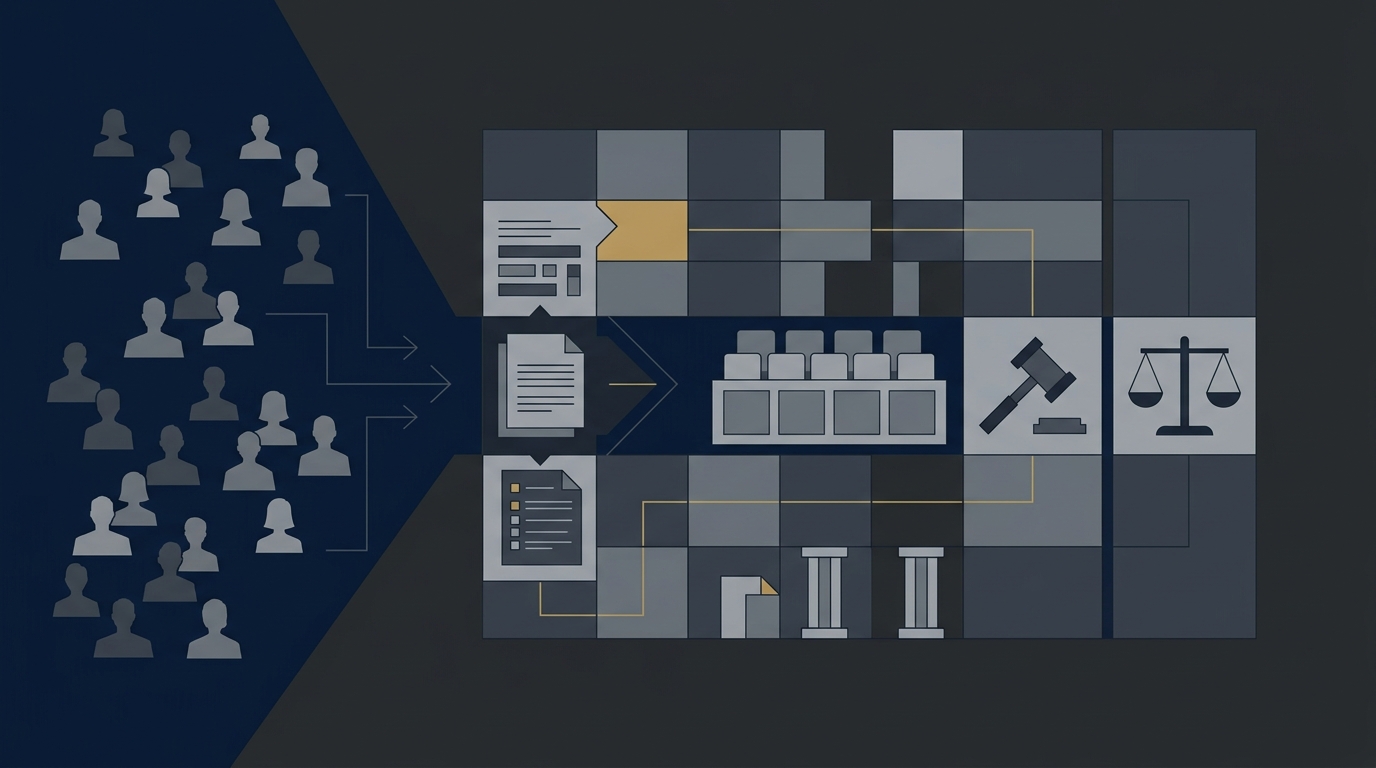
A juror questionnaire that comes back with 60 completed forms the morning of trial is not a finished product — it's a sorting problem. The direct answer: treat every questionnaire response as one of four triage categories — background-only, clarification-needed, private-sidebar, or potential-cause — and assign each non-clear answer a one-line follow-up objective before oral voir dire begins. Counsel who skip this reconciliation step either burn scarce questioning time confirming facts that don't matter, or let a material disclosure slip past without inquiry. Neither failure serves the client, and neither builds a defensible record if a challenge for cause is denied and preserved for appeal.
Most continuing legal education on juror questionnaires focuses on drafting: which questions to ask, how to phase open-ended versus closed-ended items, how long the form should run. That guidance matters, but it assumes the harder work happens before the form goes out. In practice, the harder work happens after it comes back. A stack of answers, by itself, decides nothing. What turns a questionnaire into an effective pretrial screening system is a disciplined process for reconciling ambiguous, incomplete, or sensitive responses before anyone stands up to question the panel.
Why juror questionnaires function as triage, not voir dire
Federal Rule of Civil Procedure 47(a) permits the court to conduct voir dire itself while still requiring that counsel be given the opportunity to propose additional inquiry, and many local rules require written questions to be submitted in advance of trial.[1] Courts have likewise recognized that questionnaires serve a narrower function than live questioning: they help identify plainly disqualified jurors, flag subjects that require individualized follow-up, and inform — without replacing — the challenge decisions that come later.[2] That distinction is the foundation of this entire approach. A questionnaire tells you where to look. Oral voir dire, sidebar, or individual questioning is where you look.
This matters across case types. A plaintiff's attorney in a products case might see a juror write "I think lawsuits are mostly frivolous" — that's not disqualifying on its face, but it's a potential-cause flag requiring a focused follow-up question about whether the juror can set that view aside. A criminal defense attorney reviewing a questionnaire that shows a juror's cousin works in law enforcement needs to determine whether that relationship creates actual or implied bias, not simply assume it does. A corporate defense team facing a juror who disclosed prior employment at a competitor needs the same careful separation of fact from conclusion. And a prosecutor evaluating a juror who wrote "yes" to "have you or a family member been a victim of a crime similar to the charges here" needs the underlying facts before deciding whether to pursue a cause challenge or accept a curative answer.
The four-category follow-up matrix
The matrix below organizes incoming answers by what they require next — not by subject matter. The same "yes" answer about prior litigation experience might land in a different column depending on how it's phrased and what else is on the form.
Background-only
These are answers that confirm demographic or experiential facts: occupation, marital status, education level, neighborhood, or generic litigation history with no stated opinion attached. The correct pre-voir-dire action is to code and summarize these answers — not to spend oral questioning time re-confirming them. The only reason to raise a background-only answer live is if the fact bears directly on a party, a witness, an industry involved in the case, or a disputed factual issue. If a juror lists an employer that happens to be a direct competitor of the defendant corporation, that fact graduates out of background-only and into clarification-needed.
Clarification-needed
This category covers blank responses, internally inconsistent dates, vague phrases such as "strong feelings," or an unexplained "yes" with no elaboration. These answers require a neutral, non-leading question prepared in advance: what did the juror mean, when did the event occur, and does it affect the juror's ability to decide this case fairly. The goal is factual completion, not persuasion. Counsel should compare the answer against other responses on the same form before drafting the follow-up — an inconsistency between two questions is often more informative than either answer alone.
Private-sidebar
Medical history, sexual assault, domestic violence, workplace discipline, bankruptcy, substance use, and sensitive family circumstances belong here. These facts need to be established, but not necessarily in front of the full panel. A standing order from the U.S. District Court for the Western District of North Carolina directs judges to ask necessary follow-up questions arising from written questionnaire answers and expressly permits cause or hardship requests to be heard at sidebar.[3] The practical lesson generalizes beyond that district: flag sensitive answers before the panel is seated for oral questioning, request individualized or sidebar treatment, and avoid repeating private details in open argument over a challenge. Confidential handling here is not a courtesy to the juror — it is also what prevents an entire panel from being contaminated by a non-party's disclosed trauma.
Potential-cause
This is the category that carries the highest stakes. It includes a relationship with a party or witness, prior involvement in the same type of dispute, a fixed legal or factual opinion, a stated inability to follow instructions, or a hardship substantial enough to affect participation. For each of these, counsel should assemble the factual basis, identify the applicable cause standard, and request focused oral questioning before asking the court to rule.[2] Challenges for cause are ordinarily raised orally, and some courts expressly contemplate sidebar consideration after questioning is complete.[1] Where the court conducts the examination itself, Rule 47(a) requires that counsel be given an opportunity for further inquiry the court considers proper.[1]
A one-line objective for every non-clear answer
A workable system assigns every single response a status — clear, incomplete, inconsistent, sensitive, or cause-related — and then forces counsel to write one sentence describing what the follow-up needs to accomplish. Two examples illustrate the discipline:
- "Determine whether prior employment with a hospital system creates a current loyalty that would affect evaluation of the medical defendant's conduct."
- "Determine whether the juror can apply the presumption of innocence despite a written statement that accused persons are usually guilty."
Notice that neither objective presumes the answer. The point of the follow-up is to test the proposition, not confirm a conclusion counsel has already reached. A juror who discloses prior litigation experience, for instance, should never be challenged automatically on that basis alone. The follow-up needs to establish the case type, the outcome, the emotional impact, the similarity to the present dispute, and the juror's current relationship to anyone involved. Only after those facts are developed does the "does this affect your ability to be fair" question make sense — and it should be asked as a standalone inquiry, not folded into a compound or argumentative question that asks the juror to resolve the ambiguity unassisted.
Building a defensible record for cause challenges
The matrix is not only a time-management tool — it is also what creates an appellate record. If a cause challenge is denied and the juror is removed with a peremptory strike instead, counsel's ability to preserve the issue depends on having developed the factual basis clearly before the ruling. Simply pointing to a questionnaire answer, without having obtained the follow-up answers establishing actual or implied bias, leaves a thin record for review.
Preserve the matrix itself alongside the completed questionnaire, the proposed follow-up questions, the court's rulings, and any objections. That combined record demonstrates two things simultaneously: that counsel did not treat a vague or incomplete answer as automatic grounds for a cause challenge, and that counsel did not allow a materially relevant disclosure to pass without inquiry. Both failures are avoidable with the same tool — a matrix applied consistently to every returned form, not just the ones that look obviously problematic on a first read.
Practical workflow before the panel is seated
In the days before trial, once questionnaires are returned, the sequence should run roughly as follows: code every answer by category, flag anything landing outside background-only, draft a one-line follow-up objective for each flagged answer, group private-sidebar items for a request to the court regarding individualized questioning, and prepare the factual-development questions for potential-cause items separately from the ultimate impartiality question. This sequencing keeps oral voir dire focused on resolving genuine ambiguity rather than re-litigating facts the questionnaire already settled, and it ensures sensitive material is raised through the correct procedural channel rather than in open court by accident.
Frequently Asked Questions
Does a juror questionnaire replace the need for oral voir dire? No. Courts treat questionnaires as a screening tool that identifies plainly disqualified jurors and flags subjects needing individualized questioning, but the challenge decision itself is informed, not replaced, by the written answers.[2]
What should counsel do with a vague answer like "I have strong feelings about this"? Treat it as clarification-needed. Prepare a neutral, non-leading follow-up asking what the feeling is based on, when it developed, and whether it affects the juror's ability to decide the case fairly, rather than assuming the answer establishes bias.
How should sensitive disclosures such as sexual assault history be handled? Request individual or sidebar questioning before the full panel hears the details. Some federal districts have standing orders directing courts to permit cause or hardship inquiries to be heard at sidebar specifically because of this concern.[3]
Is a juror's prior litigation experience automatically disqualifying? No. Counsel should develop the case type, outcome, emotional impact, similarity to the current dispute, and the juror's present relationship with any participants before reaching a conclusion about impartiality.
What record should be preserved if a cause challenge is denied? Preserve the questionnaire, the triage matrix, the proposed follow-up questions, the court's ruling, and any objection raised, since these documents demonstrate the factual basis developed before the ruling and support later appellate review.
Notes
- Federal Rules of Civil Procedure, Rule 47(a), Cornell Legal Information Institute, https://www.law.cornell.edu/rules/frcp/rule_47
- U.S. Courts / federal judiciary guidance on juror questionnaires and voir dire screening function (general federal practice commentary on juror selection procedures).
- U.S. District Court for the Western District of North Carolina, Standing Order Regarding Jury Selection Procedures, https://www.ncwd.uscourts.gov/
See how StrikeList AI fits your next trial.
Buy a single trial and start today, or request a short demo to see the workflow on a real panel.