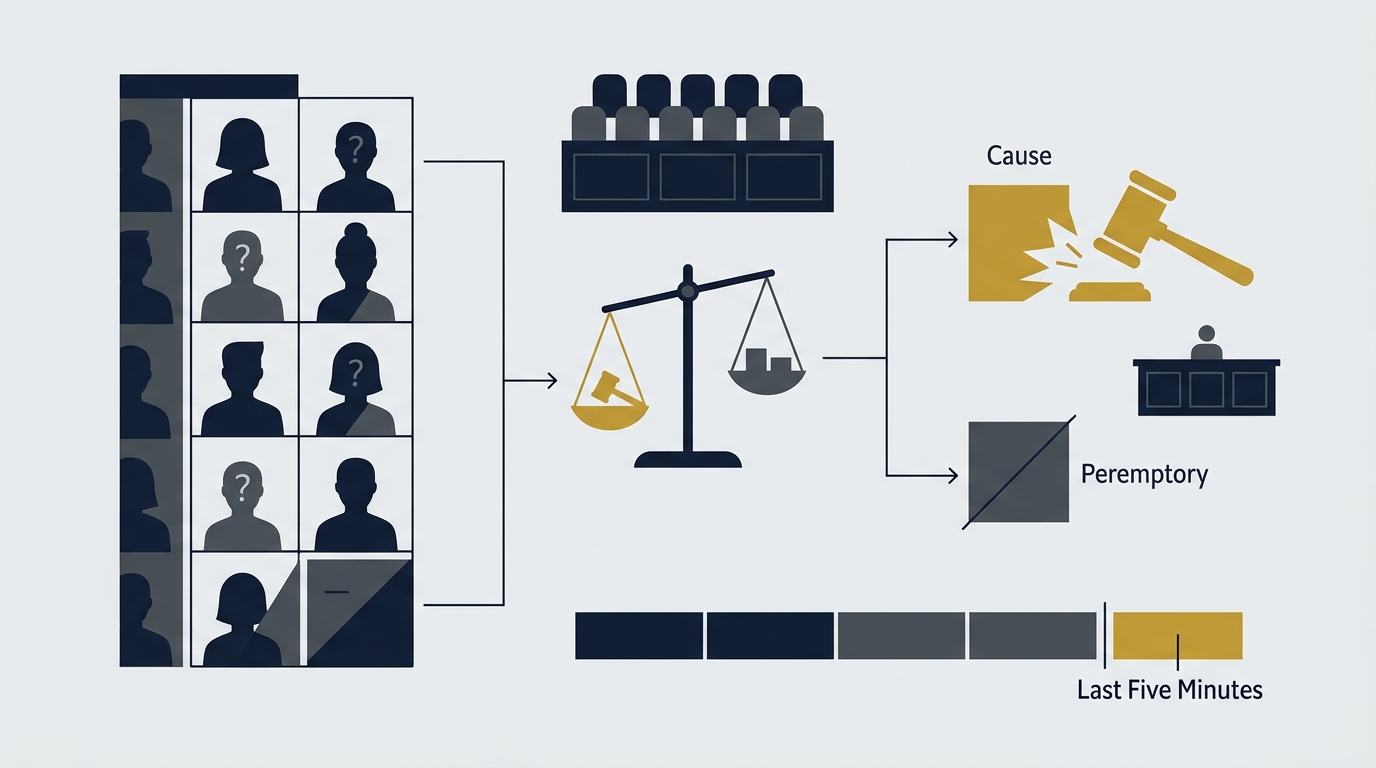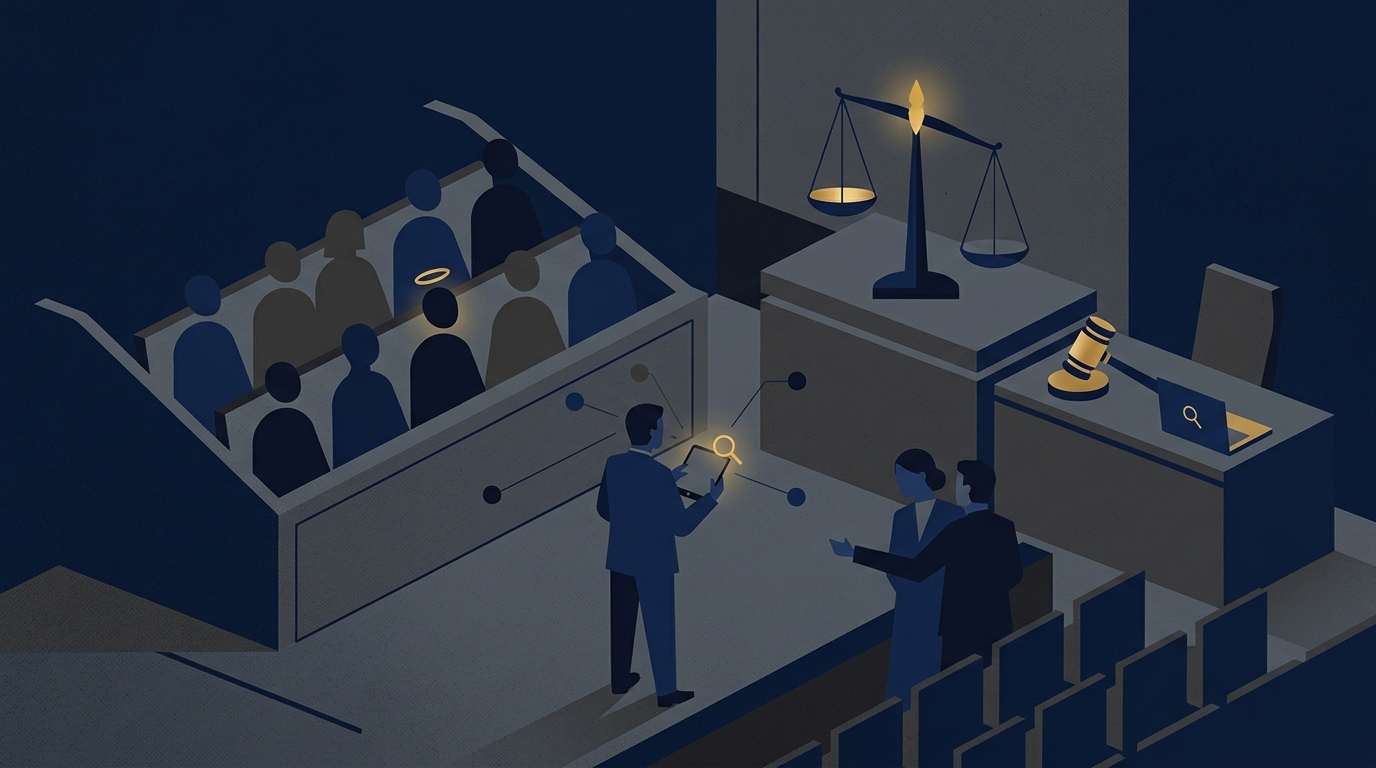
If your team finds something about a juror while questioning is still underway, the question isn't whether you're allowed to keep looking. It's whether what you found can still change the outcome, and if it can, whether you tell the judge now or wait. The direct answer: research only public information, assign it to one screened team member who never talks to jurors, stop once you have enough to decide on a challenge or protection, and disclose material findings to the court before the panel is sworn, not after.
Most of what's been written about juror research covers the easy part, what records you can pull before trial starts. Property records, voter files, public social media, all fair game under the usual rules. What gets less attention is the harder, faster decision that happens in real time once a venire member is in the box answering questions: do you keep searching while opposing counsel is still talking, when do you stop, and if you find something, do you raise it right then or save it for a motion later. That moment-to-moment judgment call is the subject of this piece.
Why Live Juror Research During Voir Dire Is Different From Pretrial Research
Pretrial research happens on your schedule. You pull names from the jury pool list, run them through whatever databases your firm uses, and build a profile before anyone sets foot in the courtroom. Live juror research during voir dire is nothing like that. It's happening while a juror is still answering a question, while opposing counsel is making their own read of the panel, and while the judge is watching the clock. There's no time to second-guess a search, and there's no undo button if your researcher accidentally triggers a notification or sends a friend request.
ABA Formal Opinion 466 addresses this directly. It permits passive review of a juror's publicly available internet presence, including during trial, unless a law or court order says otherwise.[1] The word "passive" is doing the work there. Lawyers and their staff may not send friend requests, follow requests, connection requests, or anything else that requires the juror's awareness or action. Those requests count as prohibited ex parte communications under Model Rule 3.5(b).[1][2] A LinkedIn connection request sent to a sitting juror isn't a gray area. It's a rule violation, full stop.
What the Court's Order Actually Controls
Before voir dire starts, ask the judge three things: whether live searches are permitted at all, whether they can continue after the jury is seated, and whether the parties have to disclose the practice to the venire. Some courts have required counsel to tell prospective jurors upfront that internet research will happen, including during trial.[3] If the judge's standing order is silent on live research, don't assume silence means permission. Raise it at the pretrial conference and get a clear answer on the record. A misstep here doesn't just risk a sanction against your firm, it can hand the other side a post-verdict challenge based on juror taint that nobody wants to litigate.
Building a Protocol for Live Juror Research During Voir Dire
A defensible protocol has structure before the first juror is ever called. Three roles, separated cleanly: one researcher, one decision-maker, and one courtroom liaison. The researcher does not question jurors and does not talk to them, period. Mixing those roles is how firms end up explaining to a judge why their trial lawyer also happens to be the person who looked at a juror's Facebook page an hour earlier.
Every search goes into a written log: juror identifier, time, platform, search terms used, the URL or a screenshot, and a note on whether the information has been verified. If this ever gets challenged, that log is what separates "we ran a reasonable, documented process" from "we don't actually know what we looked at or why."
The Trigger Rule: Search for a Reason, Not Out of Curiosity
Searches should start from an objective trigger, not idle interest. A disclosed name tied to a legitimate concern: a potentially disqualifying relationship the juror mentioned, an answer that needs clarification, or a public statement that bears directly on impartiality. What you're not doing is running broad curiosity searches or digging for protected personal characteristics that have nothing to do with the case. If you can't articulate the reason for a search in one sentence before you run it, don't run it.
Verify Before You Act on Anything
Common names produce false hits constantly. Before you treat anything as real, require at least two matching identifiers, employer plus city, photo plus age range, something that actually ties the account to the specific juror in the box. An algorithm's "people you may know" suggestion is not evidence. An unauthenticated account with the right name and nothing else confirming it is not evidence either. Acting on a bad match can do more damage to your credibility with the court than finding nothing at all.
Classify What You Find
Once you've confirmed identity, sort the result. Harmless background, a juror's hobby or employer, goes in one bucket. Anything suggesting bias, concealment, outside knowledge of the case, contact with a party or witness, coercion, or juror misconduct goes in another. Only the second bucket matters for a stopping decision or a disclosure decision.
When to Stop Researching a Juror
This is the part most firms skip, and it's where things go wrong. Stop once you've confirmed a reliable identity and have enough to decide whether to seek further questioning, exercise a challenge, request a curative instruction, or ask for other relief. There's no additional value in continuing to dig once you've reached that point. Continued searching past that line does one of two things: it either accumulates embarrassing or irrelevant personal information that has nothing to do with the trial, or it increases the risk that someone on your team accidentally interacts with the juror's content, likes a post, views a story that notifies the account, or otherwise crosses from passive review into contact.
Set the stopping rule before voir dire begins, not in the middle of it. If your researcher needs to ask the decision-maker "should I keep going," the answer should already be built into the protocol: stop when the marginal information can't change a lawful challenge or protect the integrity of the trial.
Pause Before Anyone Communicates
No one on the research side contacts the juror, reacts to their content, requests access, uses a fake or anonymous account to view restricted material, or has a third party do any of that on their behalf.[1][2] If your team needs a workaround to see something, that's the signal to stop, not to get creative.
Disclosure Obligations: When a Hit Must Go to the Judge
Opinion 466 is specific that discovering criminal or fraudulent juror misconduct requires reasonable remedial measures, which can include disclosure to the tribunal when necessary.[1] In practice, disclosure is strongest, and often mandatory, when a search turns up criminal or fraudulent conduct, material nondisclosure during questioning, prohibited contact with a party or witness, outside research the juror has done on the case, or anything suggesting the juror can't remain impartial.
The timing matters as much as the substance. A hit should ordinarily be disclosed before the panel is sworn or seated whenever it could support a challenge for cause, a peremptory strike, further questioning, removal of a seated juror, or a protective instruction. Sitting on it risks forfeiting the issue entirely, and it can make a lawyer look like they were sandbagging favorable information for later, which is a bad position to be in whether you represent the plaintiff, the defendant, or the state.
What Disclosure Should Actually Sound Like
Counsel discloses the fact and its apparent significance. Not more than that. Don't overstate how authentic the material is, and don't argue the ultimate conclusion for the judge. A workable version:
"Your Honor, during permitted public research, the team located information potentially relevant to Juror No. _. We have preserved it, have not contacted the juror, and request a sidebar or in-camera inquiry before the panel is seated."
That phrasing does three things at once: it tells the judge what happened, confirms no contact occurred, and asks for the court to control the next step rather than the lawyer arguing it in open court in front of the rest of the panel.
How the Decision Changes by Role
A prosecutor finding a venire member's prior arrest record or a social media post expressing hostility toward police has a straightforward basis to raise it before the panel is seated, since it goes directly to impartiality in a case the state is trying. Criminal defense counsel facing the same situation in reverse, a juror whose posts suggest sympathy for law enforcement beyond the norm, carries the same disclosure obligation even though the finding cuts against the client. Opinion 466 doesn't create an exception for which side the information helps.
A plaintiff's attorney in a personal injury case who finds that a juror has posted extensively about a prior lawsuit or an insurance dispute has an objective trigger tied directly to bias on the exact subject at trial, which is a stronger basis for disclosure than a search run on pure curiosity about a juror's politics. Corporate defense counsel in the same case should apply the identical stopping rule: once the juror's relevant history is confirmed, additional digging into unrelated personal matters adds risk without adding decision-making value.
Across all four perspectives, the protocol doesn't bend based on who benefits. The research either meets the trigger, verification, and stopping standards or it doesn't, and the disclosure obligation doesn't shrink because the finding happens to favor your client.
FAQ
Can a lawyer view a juror's public Instagram or Facebook profile during jury selection? Yes, provided the review is passive. ABA Formal Opinion 466 permits reviewing a juror's publicly available internet presence, including during trial, unless a court order or local rule says otherwise.[1] No request for access, connection, or follow can be sent to the juror.
Is it a rule violation to send a juror a friend request to see a private profile? Yes. Friend, follow, or connection requests directed at a juror are treated as prohibited ex parte communications under Model Rule 3.5(b), regardless of whether the juror responds.[1][2]
When does a lawyer have to tell the judge about something found on a juror's social media? Disclosure is ordinarily required, or at least strongly advisable, before the panel is sworn or seated when the information could support a challenge for cause, a peremptory strike, further questioning, or a protective instruction. Discovery of criminal or fraudulent juror misconduct specifically calls for reasonable remedial measures, which can include telling the court.[1]
Who should conduct live research during voir dire, the trial lawyer or support staff? A screened team member separate from the lawyer questioning the panel. The researcher should not communicate with jurors or participate in questioning, and the decision on whether to escalate a finding to the court should rest with the trial lawyer, not the researcher.
What should a research log include? At minimum, the juror identifier, the time of the search, the platform used, the search terms, a URL or screenshot of the result, and a note on whether the identity has been verified with at least two matching identifiers.
Does the protocol change if the court hasn't addressed live research in a standing order? Silence shouldn't be read as permission. Counsel should raise the question at the pretrial conference and get the court's position on record before relying on live research during voir dire.
A Closing Note on Process
None of this works as an improvised judgment call made mid-trial. The firms that handle live juror research defensibly are the ones that built the protocol before the first panel walked in: a designated researcher, a clear trigger rule, a verification standard, a stopping point, and a disclosure script ready to go. Tools like StrikeList AI can help organize that research log and keep the paper trail clean, but the underlying discipline, searching with a reason and stopping when the reason is satisfied, is a decision every trial team has to make for itself, case by case.
Notes
- American Bar Association, Formal Opinion 466: Lawyer Reviewing Jurors' Internet Presence, April 24, 2014, https://www.americanbar.org/content/dam/aba/administrative/professional_responsibility/formal_opinion_466.pdf
- American Bar Association, Model Rules of Professional Conduct, Rule 3.5: Impartiality and Decorum of the Tribunal, https://www.americanbar.org/groups/professional_responsibility/publications/model_rules_of_professional_conduct/rule_3_5_impartiality_decorum_of_the_tribunal/
- ABA Formal Opinion 466, discussion of trial court practices requiring disclosure of internet research scope to the venire, April 24, 2014, https://www.americanbar.org/content/dam/aba/administrative/professional_responsibility/formal_opinion_466.pdf
See how StrikeList AI fits your next trial.
Buy a single trial and start today, or request a short demo to see the workflow on a real panel.