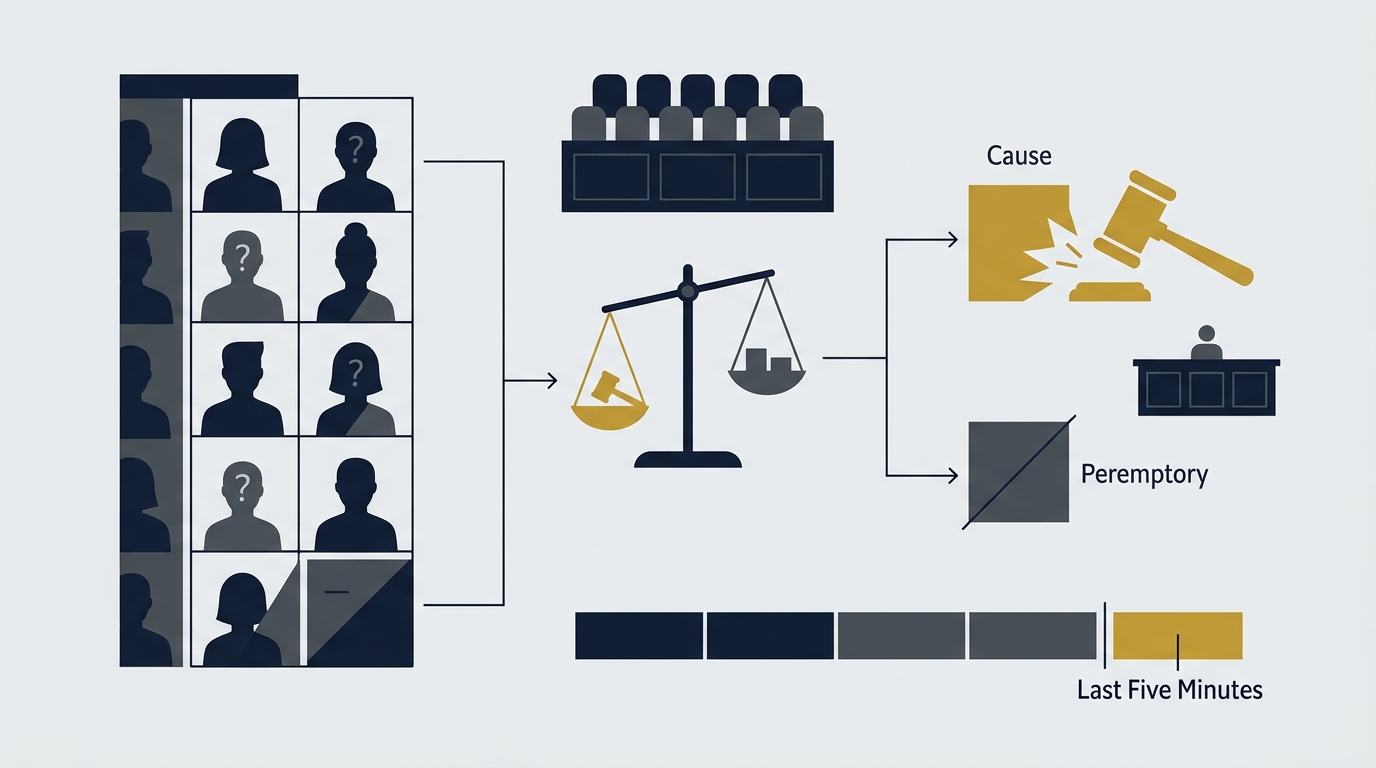
You've used every peremptory but one. Two jurors remain who worry you, but not in the same way. Juror A said something that suggests she'll anchor low on damages. Juror B gave you nothing, polite, vague, guarded answers that could mean he's thoughtful or could mean he's hiding something. Which one do you strike?
The direct answer: you don't pick the juror you dislike more. You pick the one whose presence on the final panel creates the greater expected harm once you account for how confident you actually are in that risk and how easily the remaining venire could replace it. That requires comparing the two jurors against each other, not scoring each one in isolation against an imaginary ideal juror who was never on your panel to begin with.
Most voir dire training treats the final strike as the last step in a single-juror checklist: rate hostility, rate bias indicators, strike the low scorer. That approach breaks down exactly when it matters most, at the end, when your remaining risks are serious but different in kind. This is a portfolio decision, not a sorting exercise.
The legal floor for any peremptory strike decision
Before you build any framework for your final peremptory strike, you need to be clear about what the strike can and cannot be based on. Peremptory challenges are limited and discretionary, unlike challenges for cause, which are unlimited but require a specific showing of bias or inability to serve.[2] That discretion has a hard constitutional boundary. In Batson v. Kentucky, 476 U.S. 79 (1986), the U.S. Supreme Court held that purposeful racial discrimination in peremptory challenges violates equal protection, and set out a three-step process: an inference of discrimination, a race-neutral explanation from the striking party, and a judicial finding on purposeful discrimination.[1][6] That rule isn't limited to prosecutors. Georgia v. McCollum, 505 U.S. 42 (1992), extended it to criminal defendants as well.[8]
Practically, this means your risk-tradeoff matrix for the final peremptory strike has to run on case-relevant statements, specific experiences, demonstrated reasoning, and observed group dynamics. It cannot run on race, sex, or stereotype, even informally, even as a mental shortcut you'd never say out loud. There's research suggesting that simply telling attorneys to avoid race- and gender-based reasoning doesn't eliminate the underlying bias. It can just push lawyers toward more elaborate after-the-fact justifications that sound neutral but aren't.[3] The fix isn't vigilance alone. It's building your reasoning in real time, on the record, tied to specific facts, so you're not reconstructing a justification after the fact.
The pairwise risk-tradeoff matrix for your final peremptory strike
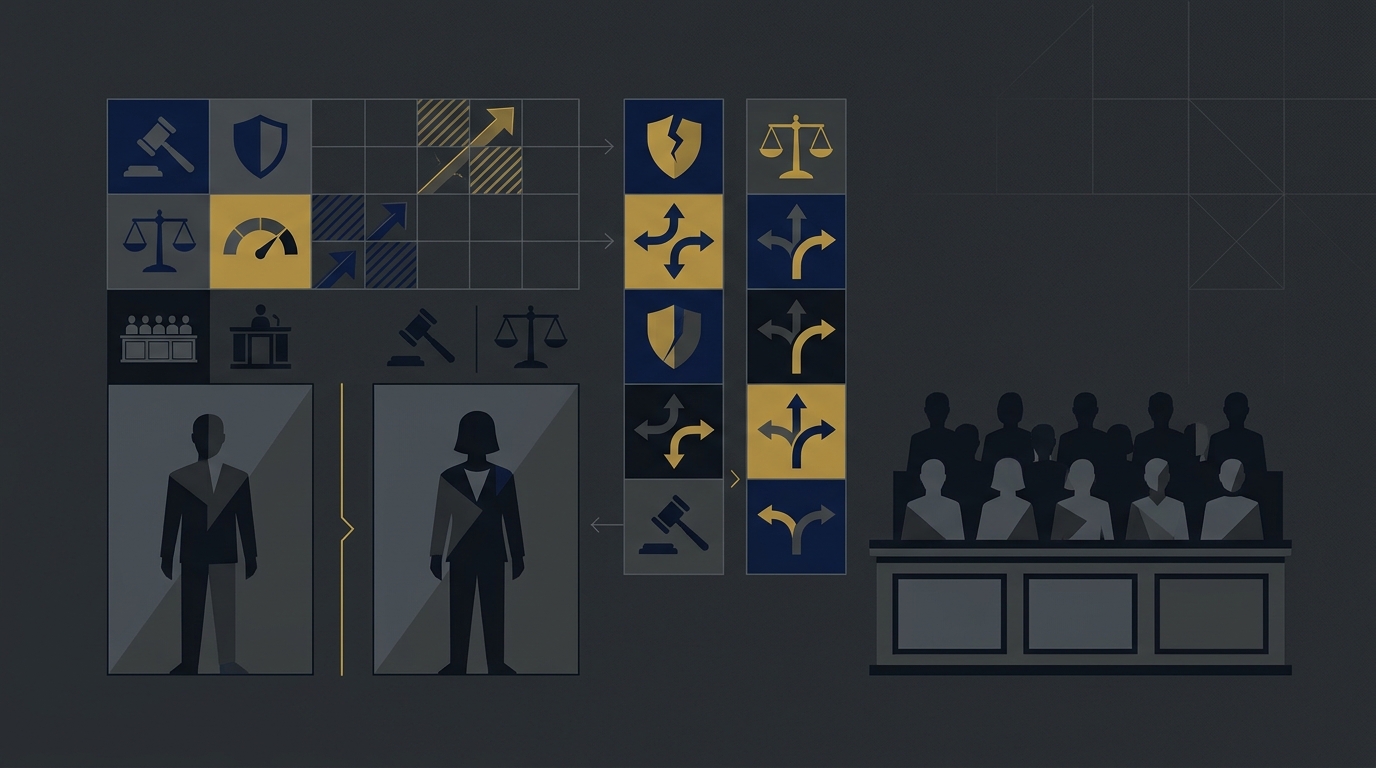
Here's the structure. Score Jurors A and B across four questions on a 1 to 5 scale. The number isn't the point. The discipline of answering each question separately, for each juror, is the point.
Severity asks: if this juror persuades others in deliberation, how much could that swing liability, damages, credibility findings, or punishment? A juror who might cap damages at a modest number is a different kind of risk than a juror who might hang the jury entirely.
Confidence asks: how much of this risk is built on actual evidence from voir dire, as opposed to a gut read? A juror who stated outright that she thinks damages awards are generally excessive gives you high confidence. A juror who just seemed a little cold gives you low confidence, even if your instinct says otherwise.
Replaceability asks: if you strike this juror, how likely is the next juror called from the venire to be a safer bet? If your pool is thin, keeping a moderate risk you understand may beat gambling on an unknown replacement.
Panel effect asks: does this juror amplify or dampen risks already sitting in the box? A juror with a strong personality sitting next to someone already inclined toward your opponent's position is a different problem than the same juror sitting among people likely to check him.
Once you've scored both jurors, ask the actual decision question: which juror creates the worse expected panel outcome if kept, after you've accounted for your uncertainty and for what the remaining venire can realistically offer instead?
A rough way to hold this together:
Strike priority = (severity × confidence) + panel effect − replaceability
This isn't a prediction model, and you shouldn't treat it like one. Its job is narrower: it stops a vivid, scary-sounding concern with no real evidentiary support from automatically beating a quieter, better-documented risk. Lawyers are pattern-matchers under time pressure, and the loud problem usually wins the room unless you force a structured comparison.
%27%2C%27data%27%3A%5B4%2C4%2C2%2C3%5D%2C%27backgroundColor%27%3A%27%234e79a7%27%7D%2C%7B%27label%27%3A%27Juror%20B%20score%20(1-5%20scale)%27%2C%27data%27%3A%5B3%2C2%2C4%2C2%5D%2C%27backgroundColor%27%3A%27%23f28e2b%27%7D%5D%7D%2C%27options%27%3A%7B%27scales%27%3A%7B%27yAxes%27%3A%5B%7B%27scaleLabel%27%3A%7B%27display%27%3Atrue%2C%27labelString%27%3A%27Score%20per%20dimension%20(1%20to%205)%27%7D%2C%27ticks%27%3A%7B%27min%27%3A0%2C%27max%27%3A5%7D%7D%5D%7D%7D%7D) Illustrative scoring example showing how severity, confidence, replaceability, and panel effect can diverge between two jurors.
Account for what questioning did not reveal
Your final peremptory strike decision usually involves at least one juror who didn't give you much. That's not a reason to assume the worst. It's a reason to track the gap explicitly rather than let it quietly become a certainty in your head.
For each juror, write down what they actually said, what they declined or failed to answer, what assumption you're making to fill that gap, whether that gap is outcome-critical to your case theory, and whether voir dire gave you a real chance to test it or you simply ran out of time.
Low confidence doesn't automatically mean low risk. A juror who gives guarded, inconsistent, or oddly generic answers can be worth a targeted concern. But label that concern as uncertainty. Don't dress it up as a finding. Empirical research on jury selection has consistently found that lawyers' ability to predict how an individual juror will actually vote from surface traits and demeanor is limited, and that social dynamics inside the deliberation room can override whatever individual tendency you thought you identified during questioning.[9] That's a real limit on what this whole exercise can do for you, and it's worth sitting with rather than talking yourself past it.
Model the whole panel, not just the two names in front of you
The final strike doesn't just remove a juror. It reshapes the group that's about to deliberate. Before you commit, ask whether keeping Juror A gives an already dominant personality an ally, leaves a likely deliberative leader unchecked, adds a probable holdout or a probable compromise voter, shifts the panel's concentration of professional or litigation experience, or makes the group more receptive to the story the other side is going to tell.
This is the real reason a single-juror checklist fails at this stage. The unit that matters isn't A or B evaluated alone. It's the twelve or six people who are about to sit in a room together, and how A or B changes what that room does.
How the calculus shifts by role
A plaintiff's lawyer weighing a final strike is usually watching for anchoring behavior on damages and for jurors likely to minimize pain, lost function, or credibility of a treating physician. The severity score climbs fast for any juror who's expressed skepticism about damages in general.
A criminal defense lawyer is often weighing a juror who seems pro-law-enforcement against one who seems disengaged or passive. Severity here often ties to whether the juror is likely to lead the room toward a guilty verdict versus simply go along with whoever speaks first.
Corporate defense counsel frequently sees the tradeoff differently: a juror with strong anti-corporate sentiment weighed against a juror who seems sympathetic but inexperienced and easily moved by a plaintiff's emotional appeal. Panel effect matters enormously here, since corporate defense cases often hinge on whether one confident juror sets the tone for a deliberation that runs long.
A prosecutor's version of this problem often involves weighing a juror who seems overly cautious about reasonable doubt against a juror who seems sympathetic to a defendant's personal circumstances. Confidence matters more here than in almost any other context, because overcorrecting on a weak signal can mean losing a fair juror based on a guess.
In every one of these postures, the same structure applies. Compare the two jurors to each other, not to an ideal you invented, and be honest about how much you actually know versus how much you're inferring.
A practical final-minute protocol
When the clock is running and the judge is waiting, you don't have time for a spreadsheet. Run this instead: state the strongest fact-based risk for each juror. State the largest uncertainty for each. Identify who's more likely to influence others in the room. Compare the real replacement pool left in the venire, not a fictional better juror. Confirm your stated reason is race- and gender-neutral and tied to something actually said or observed. Then strike the juror whose expected marginal harm to the final panel is greater.
The best final strike isn't the juror you personally like least. It's the choice that most reliably leaves you a better panel, given incomplete information and the constitutional limits set out in Batson and McCollum.
FAQ
Can I strike a juror based on a "gut feeling" if I can't articulate a specific reason? You can act on instinct, but if challenged under Batson, you'll need a race-neutral, case-specific explanation on the record.[1][6] A gut feeling alone is a weak foundation if your strike pattern draws scrutiny, so it helps to translate the instinct into a specific statement, behavior, or inconsistency you observed during questioning.
What happens if opposing counsel raises a Batson challenge on my final strike? The court will ask you to give a race-neutral explanation for the strike. If you provide one, the judge then decides whether it's genuine or a pretext for discrimination.[1][6] That's why documenting your reasoning, ideally using a framework like severity, confidence, replaceability, and panel effect, in the moment rather than reconstructing it later matters.
Does this framework apply differently in civil versus criminal cases? The legal standard is the same: Batson applies in criminal cases and its principles extend to civil cases as well, and McCollum confirms the rule binds defense strikes too, not just prosecution strikes.[1][8] What changes is the substance of severity, since civil cases often turn on damages anchoring while criminal cases often turn on burden-of-proof attitudes and perceived leadership in the room.
How do I weigh a juror who said very little during voir dire? Treat the silence as an unknown, not as evidence either way. Note what was asked, what wasn't answered, and whether you had a real opportunity to probe further. A juror who gave guarded answers may be cautious or may be concealing a view, but research on jury prediction suggests lawyers often overestimate how well they can read this from limited interaction.[9]
Is there a point where I should just keep both risky jurors and not use my last strike? If neither Juror A nor Juror B presents a severity and confidence combination you can clearly articulate on the record, declining to strike is a legitimate choice. The framework is meant to force comparison, not to manufacture a reason to strike where the evidence doesn't support one.
Jury selection decisions like this one are hard to standardize because every panel and every case theory is different. StrikeList AI is built around organizing the voir dire information attorneys gather, including answers, hesitations, and demographic-neutral behavioral notes, so that comparisons like the one above are easier to run under real time pressure rather than reconstructed afterward.
Notes
- Oyez, "Batson v. Kentucky," summary of 476 U.S. 79 (1986), https://www.oyez.org/cases/1985/84-6263
- Cornell Law School Legal Information Institute, "Peremptory Challenge," Wex, https://www.law.cornell.edu/wex/peremptory_challenge
- Equal Justice Initiative, reporting and analysis on race- and gender-based reasoning restrictions in jury selection, https://eji.org/news/
- Justia U.S. Supreme Court Center, "Batson v. Kentucky, 476 U.S. 79 (1986)," https://supreme.justia.com/cases/federal/us/476/79/
- Justia U.S. Supreme Court Center, "Georgia v. McCollum, 505 U.S. 42 (1992)," https://supreme.justia.com/cases/federal/us/505/42/
- National Center for State Courts, research summaries on jury selection and predictive limits of voir dire, https://www.ncsc.org/
See how StrikeList AI fits your next trial.
Buy a single trial and start today, or request a short demo to see the workflow on a real panel.